Randomized Comparison of Left Atrial Appendage Closure With Oral Anticoagulation After Catheter Ablation for Atrial Fibrillation
© 2025 HMP Global. All Rights Reserved.
Any views and opinions expressed are those of the author(s) and/or participants and do not necessarily reflect the views, policy, or position of EP Lab Digest or HMP Global, their employees, and affiliates.
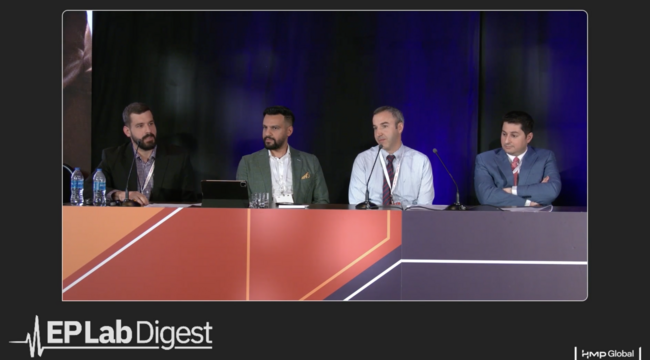
Featured is the presentation entitled "Randomized Comparison of Left Atrial Appendage Closure With Oral Anticoagulation After Catheter Ablation for Atrial Fibrillation" by Oussama M. Wazni, MD, MBA, from Session 1 at the 2025 Western AF Symposium.
Transcripts
Thank you, Nassir, for inviting me, and thank you for listening to me discuss the OPTION trial. I've been talking about it for many years, and here are the results. OPTION is very important. Even before it was published, it was being criticized. Why is it important? Because of what Dr Eric Prystowsky just told us—he said with a CHA2DS2-VASc score of 2, very few patients will have a stroke, although you do not know who it will be. Even with a CHA2DS2-VASc score of 0, patients can have a stroke.
This is even more important after an ablation. That is why the guidelines, because of the uncertainty, said that regardless of the outcome of the ablation, whether you think it's successful or not, you should continue oral anticoagulation or decide on anticoagulation depending on the CHA2DS2-VASc score. Why? We don't know. But it's a problem, because if you give anticoagulants to an ablated patient with a CHA2DS2-VASc score of 2 but they don't have atrial fibrillation (AFib), you're exposing them to bleeding. On the other hand, in that same patient, if you think they don't have AFib anymore and stop their anticoagulant, even if it's a CHA2DS2-VASc of 0, they may still have a stroke. So, that's why we conducted the OPTION trial, to evaluate the safety and effectiveness of left atrial appendage closure (LAAC) versus oral anticoagulation in patients who have had an ablation and are at a high risk of stroke.
The primary efficacy endpoint was a composite of death, stroke, or systemic embolism at 36 months noninferiority. The primary safety endpoint was nonprocedural major bleeding or clinically relevant nonmajor bleeding at 36 months. We just heard from Mellanie True Hills about patient preference, so it depends on what the patient decides regarding bleeding. But these are defined for us. These are the definitions here—I'm not going to read them. The secondary endpoint was major bleeding, including procedural bleeding at 36 months, and this was tested for noninferiority.
We randomized patients in a 1:1 fashion to ablation plus device versus ablation and anticoagulation, and we followed them for 36 months. There is a side note on the left. Patients were either sequential or concomitant. Sequential means that they had an ablation 90 to 180 days prior to randomization, and combined or concomitant means that they did anticoagulation or a device implant within 10 days of randomization.
As far as results, a total of 1600 patients were randomized to device versus anticoagulation. The follow-up was very good—this is as good as it gets with regards to follow-up. Again, OPTION is very important. Why? Because Watchman was not compared to new oral anticoagulants, but in OPTION, 95% of the patients were on direct oral anticoagulants (DOACs).
These are the baseline characteristics. I pointed out that the patients’ CHA2DS2-VASc score was 3.5 or higher, so they were high risk, and 10% in the device group versus 11.5% who had a previous stroke were high-risk patients. With regards to the sequential or combined, 60% were sequential and 40% were combined.
These are the procedure characteristics. I'm not going to go into too much detail, but most patients were under general anesthesia and most had transesophageal echocardiography to guide the device implant.
How about oral anticoagulation over time? A total of 85% of patients in the anticoagulation arm were on anticoagulation, and in the device group, it was about 10% at any one time. This is important. It's not 10% of the patients—it’s 10% of the patients at any time were on anticoagulation. Why were they on anticoagulation? Because of cardioversions and redo ablations. So, that's why we have to resume anticoagulation in these patients. Once more, 95% of patients were taking a DOAC.
The efficacy endpoint met the noninferiority margin by a lot. The margin was at 5, and we saw that it's actually better by 0.5%. To define noninferiority margins, even if the device group had been worse by 5%, we would have said that it was not inferior, but it was actually better by 0.5%. So, there was very strong noninferiority, to the point where I would have to say maybe even superiority.
Here are the components of the primary efficacy endpoint; they're consistent, and importantly, the ischemic stroke risk was low in both groups, 1.2% versus 1.3%. This is very important. There is a good message here that AFib ablation by itself reduces the risk of stroke.
The primary safety endpoint met superiority, 8.5% in the device group versus 18.1%, with a very significant P-value. Even when we add procedural bleeding, it increases the bleeding in the device group to 9.5%, but this is still much lower than the anticoagulation group of 18.1%.
The secondary endpoint also met noninferiority. Again, this is major bleeding at 36 months including procedural bleeding 3.9% versus 5%.
What were the procedural events with Watchman? There were 5 major bleeding events and 6 nonmajor bleeding events. So, it was low overall, but the important thing to note is there were no pericardial effusions in this group of patients. Across subgroups, it was consistent with the same results, again, showing noninferiority for the efficacy and superiority for the safety.
If we dig deeper in the different subgroups, all these patients had low event rates, but if you take the higher CHA2DS2-VASc score, for example, the patients do have events. Still, the Watchman FLX compared very well to continued oral anticoagulation.
What were the limitations? This was not within the era of pulsed field ablation (PFA), but I don't think this is going to change things. We've already continued to perform PFA and also left atrial appendage closure together in some cases. We did not include patients with a low ejection fraction, so that's important to take into consideration. Finally, with the open-label design, I've had patients go sooner to the doctor because they knew that they were on an anticoagulant and bruising would have sent them to the physician.
What are the conclusions? This is the first head-to-head trial of Watchman FLX versus DOACs. Again, it's never been done before on this scale. There was equivalent thromboembolic protection at 3 years, 1.2% versus 1.3%, and there was a reduced risk of major clinical and clinically relevant nonmajor bleeding with much better outcomes in the device group.
What are the clinical implications? Watchman FLX is very safe and I think it's a very good first-line option for AFib patients. You don't have to worry about whether to stop anticoagulation or continue anticoagulation in these patients. Regarding combined AFib ablation and left atrial appendage closure in the OPTION study, 40% of the patients had a combined procedure. So, if you have one procedure that decreases the burden of AFib as well as decreases the risk of stroke and bleeding, why wouldn't you want to do it? You can save the patients a lot of hassle and trouble.
These were our investigator teams, sites, and patients, and I want to thank them all for being part of the study. If you would like further reading, please read the paper and also the supplement, which has a lot of important information. Thank you very much.
The transcripts have been edited for clarity and length.
Related Content