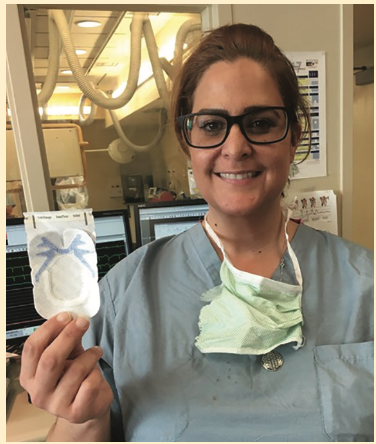
Figure 1. Roya Lisboa, RN, holding a SorbaView bandage (Centurion Medical Products).
Small innovations can make a big difference. It’s a recurrent theme in interventional cardiology. Small changes or new application of a common piece or equipment, supply, or method can make a difference in your lab.1,2
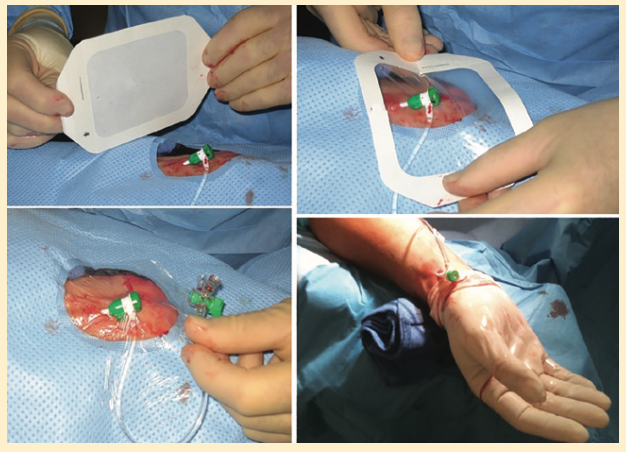
Figure 2. The Tegederm bandage being applied to the radial sheath. Lower right, view of draping for our radial procedures using the Armen glove method.3
Last week, Roya Lisboa (Figure 1), one of our super cath lab nurses, handed me an IV bandage to secure the radial sheath. I’d been complaining, as many of my colleagues have reported, that the usual Tegederm clear plastic bandage (Figure 2) with a slit, holds the sheath in place for most routine cases but fails for longer procedures, especially when blood gets under the plastic.
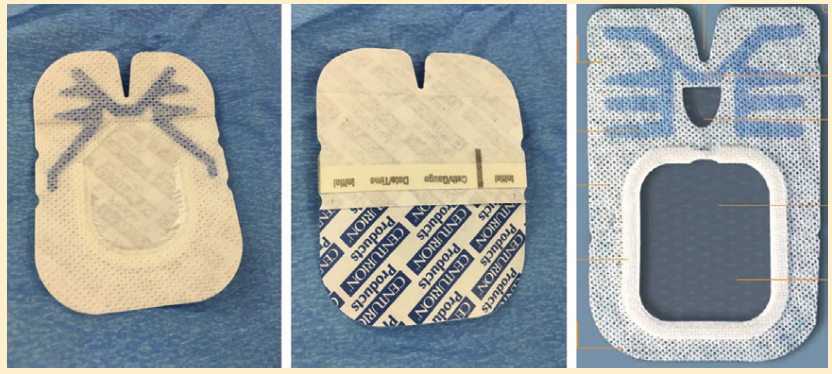
Figure 3. The SorbaView bandage. Left, adhesive side before removal of paper covers; middle, front side of SorbaView bandage; right, different size SorbaView bandage showing clear window and a port to see hub of catheter/sheath/IV. Blue lines are reinforcing tapes incorporated into bandage.
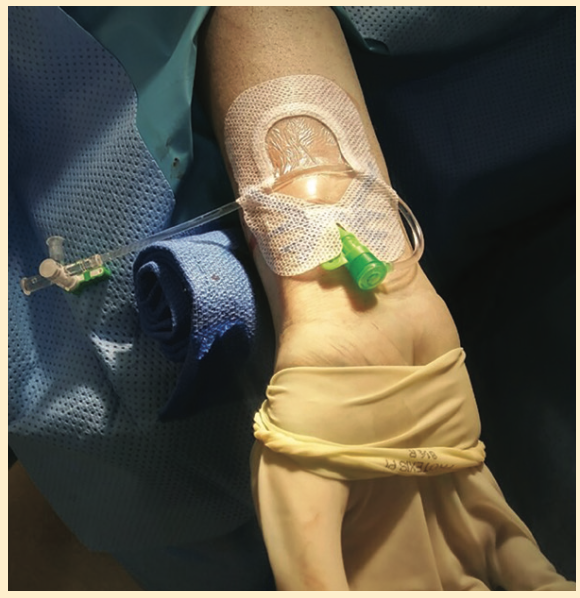
The SorbaView bandage (Centurion Medical Products) (Figure 3) has a clear window and fabric adhesive border with a locking piece of adhesive added after the bandage is placed. It is usually used to protect IV needles and catheters. The fabric border prevents blood from leaking into the puncture area. To secure the radial sheath, we made sure to attach the fabric adhesive to the hub of the sheath with the side arm passing under the adhesive and the locking patch over the side arm (Figure 4).
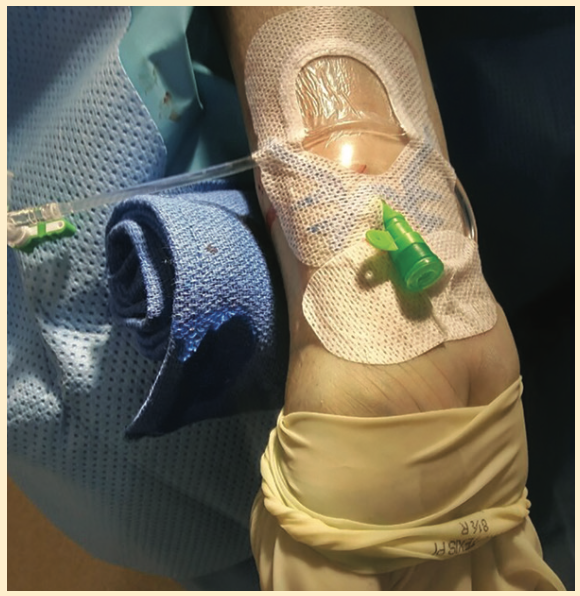
Figure 4A. Application of the SorbaView bandage to the radial sheath. The fabric tape is adhered to the sheath hub. The side arm is looped to the top of the arm and covered by the SorbaView clear window and fabric border.
I asked my expert colleagues what they used for securing their radial sheaths and the answers were interesting:
Most respondents used Tegederm, but complained that its securing function is short-lived and if blood gets under it, it is a mess and stops working. This usually occurs involving a long case with multiple catheter exchanges.
Figure 4B. Final SorbaView application with locking patch holding the side arm as it exits the sheath. The bandage stayed dry for the entire procedure and was easy to remove.
Several operators use long sheaths with no securing technique needed.
Several operators use a suture if the sheath needs to be secured for long case.
One European operator doesn’t use sheaths and goes sheathless for his procedures.
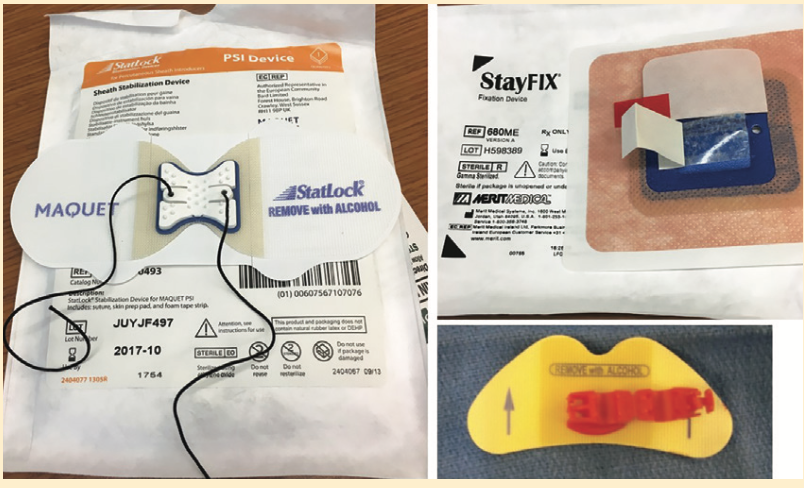
Figure 5. Three sheath-securing devices. Left, Statlock (Maquet); top right, StayFIX (Merit Medical); bottom right, StatLock arterial ultra-stabilization device (Bard Access Systems).
Several other devices available in our lab were investigated but none seemed suitable (Figure 5). While only a small change in our radial technique, the use of a new securing method may be a big advance for the procedure. It’s always a good idea to keep your eyes open in the cath lab.
References
Kern MJ. New ideas from cardiac cath lab staff. Cath Lab Digest. 2008 Mar; 16(4). Available online at https://www.cathlabdigest.com/articles/New-Ideas-Cardiac-Cath-Lab-Staff. Accessed Dec 12, 2017.
Kern MJ. Small innovations can make a big difference: the role of staff initiatives to drive efficiency in the cath lab. Cath Lab Digest. 2017 Feb; 25(2). Available online at https://www.cathlabdigest.com/article/Small-Innovations-Can-Make-Big-Difference-Role-Staff-Initiatives-Drive-Efficiency-Cath-Lab. Accessed December 12, 2017.
Kern MJ. The Armen glove for radial access prep — a better way. Cath Lab Digest. 2010 May; 18(5). Available online at https://www.cathlabdigest.com/articles/The-Armen-Glove-Radial-Access-Prep-%E2%80%93-A-Better-Way. Accessed December 12, 2017.
“This early feasibility study for J-Valve is encouraging," said Dean J. Kereiakes, MD, MSCAI. "It shows that a dedicated device designed for aortic regurgitation can achieve sustained valve performance, meaningful symptom improvement, and...
“This early feasibility study for J-Valve is encouraging," said Dean J. Kereiakes, MD, MSCAI. "It shows that a dedicated device designed for aortic regurgitation can achieve sustained valve performance, meaningful symptom improvement, and...
A pacemaker without a box under the skin. Without wires to the heart. And without a battery that needs to be replaced every 7-10 years. It sounds like something from the distant future, but Dutch researchers at biotech company PacingCure have...
A pacemaker without a box under the skin. Without wires to the heart. And without a battery that needs to be replaced every 7-10 years. It sounds like something from the distant future, but Dutch researchers at biotech company PacingCure have...
The U.S. IDE study program will evaluate the purpose-built Shockwave™ SkyRunner Carotid IVL System designed to address the challenges of calcification in carotid arteries prior to stenting.
The U.S. IDE study program will evaluate the purpose-built Shockwave™ SkyRunner Carotid IVL System designed to address the challenges of calcification in carotid arteries prior to stenting.
ARLINGTON, VA — The Society of Cardiovascular Computed Tomography (SCCT) selected Ido Avivi, MD as the second recipient of the Chinnaiyan Catalyst Award for Women's Cardiovascular Health Research.
The award — established in 2025 by SCCT...
ARLINGTON, VA — The Society of Cardiovascular Computed Tomography (SCCT) selected Ido Avivi, MD as the second recipient of the Chinnaiyan Catalyst Award for Women's Cardiovascular Health Research.
The award — established in 2025 by SCCT...
Junkosha, pioneers of sophisticated fluoropolymer application technologies, has concluded its highly successful third Technology Innovator of the Year Award through a live stream YouTube ceremony held on June 17th 2026. Up first was Dr....
Junkosha, pioneers of sophisticated fluoropolymer application technologies, has concluded its highly successful third Technology Innovator of the Year Award through a live stream YouTube ceremony held on June 17th 2026. Up first was Dr....
Key Highlights
The Volante Steerable Guiding Sheath is designed to facilitate intracardiac, renal and peripheral placement of diagnostic and therapeutic devices.
With five different lengths and six different French sizes,...
Key Highlights
The Volante Steerable Guiding Sheath is designed to facilitate intracardiac, renal and peripheral placement of diagnostic and therapeutic devices.
With five different lengths and six different French sizes,...
Treating patients within 12 hours of diagnosis may be associated with greater improvement in acute hemodynamic and right ventricle measures compared to treatment after 12 hours, with similar safety outcomes between groups.
Treating patients within 12 hours of diagnosis may be associated with greater improvement in acute hemodynamic and right ventricle measures compared to treatment after 12 hours, with similar safety outcomes between groups.
The most notable enhancement is the ability to view medical images directly within the app. This long-awaited feature enables care teams to review imaging in real time.
The most notable enhancement is the ability to view medical images directly within the app. This long-awaited feature enables care teams to review imaging in real time.
AK-AVS, which received FDA Breakthrough Device Designation in October 2024, is an ECG-based AI algorithm intended to aid in the diagnosis of moderate to severe aortic valve stenosis in adult patients 22 years and older, utilizing data derived...
AK-AVS, which received FDA Breakthrough Device Designation in October 2024, is an ECG-based AI algorithm intended to aid in the diagnosis of moderate to severe aortic valve stenosis in adult patients 22 years and older, utilizing data derived...