










‘Upping the Score’ With a Non-Compliant, Directional Scoring Balloon for Simple to Complex Peripheral Lesions
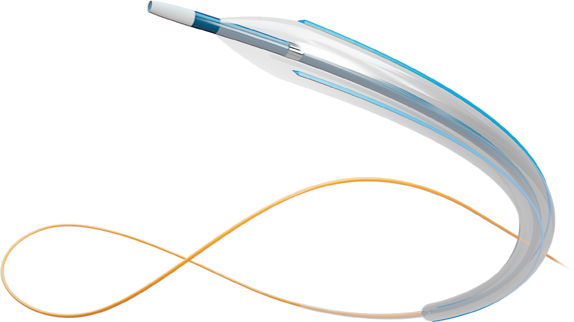
Clinical experience with a new directional scoring balloon for complex peripheral lesions will be presented at LINC on Thursday, outlining the potential benefits of its novel features for ensuring high localized force delivery, effective dilatation, and reduced vessel injury.
DKuttingTM LL (DK Medtech) is intended for dilatation of peripheral lesions in the iliac, femoral, iliofemoral, popliteal, infrapopliteal, and renal arteries, and has now obtained approval in European and US markets.* As a third-generation specialty scoring balloon, it is positioned to overcome some of the limitations of previous technologies based on constrained/ caged, guidewire-scoring and blade element designs, including inhibited or uncontrolled dilatation, residual stenosis, or short/rigid designs.
The DKutting LL device has three standout features:
Triangular scoring elements (focused force): DKutting LL uses three scoring elements with a triangular geometry intended to deliver precise and high focal force to the vessel wall. This effectively increases cutting depth and ensures uniform and powerful dilatation. By concentrating force at defined points on the lesion, effective scoring against calcium and fibrous tissue can be achieved even at relatively low inflation pressures, supporting controlled microinjury and compliance modification without relying on diffuse high pressures.
Fixed 120° distribution (controlled dilation): The three directional scoring elements are fixed and evenly distributed at 120° intervals, thereby offering uniform, controlled dilatation of stenotic lesions. This helps prevent blunt force dissections and excessive intima damage, effectively reducing the incidence of flow-limiting dissections.
Nitinol coiled-wire technology (deliverability): The scoring element construction uses a nitinol coiled-wire design intended to combine tensile strength with flexibility and trackability through tortuous anatomy – an important practical consideration for long lesions and angulated segments.
The system is currently available on 0.014” and 0.018” platforms, with diameters of 2.5–7.0 mm and lengths of 20–150 mm. Nominal pressure is 10 atm and rated burst pressure is 14 atm.
The acute performance and safety of DKutting LL were evaluated in DELTA, a prospective, multi-center, noninferiority randomized study comparing DKutting LL with the Chocolate® PTA semi-compliant balloon (Medtronic). Focused on femoral and popliteal artery stenosis and occlusion, DELTA was conducted across 14 sites in China with 188 patients randomized 1:1. Follow-up was reported at 30 days.
The DELTA results showed that DKutting LL achieved higher technical success (83.1% versus 69.4%) and significantly lower residual diameter stenosis (27.79% versus 30.87%; p=0.0212), compared to Chocolate®.
Clinical Cases Using DKutting LL

San Giovanni di Dio Hospital, Florence, Italy
Lorenzo Patrone (San Giovanni di Dio Hospital, Florence, Italy) will present early experience with DKutting LL, describing it as his new preferred balloon for complex peripheral lesions and longer disease segments.
Speaking to LINC Today ahead of his presentation, Dr Patrone noted that, while plain old balloon angioplasty (POBA) remains foundational, its limitations are well recognized. “POBA has always been considered the gold standard for treatment of infrainguinal vessels, but it has now been demonstrated that its value is limited in terms of recurrence of disease, and the need for target lesion revascularization,” he said.
Dr Patrone frames the issue as one of consistency – achieving predictable luminal expansion and controlled vessel response in lesions where conventional angioplasty often falls short.
He emphasized the potential for DKutting LL to address this, particularly down to its triangular scoring architecture. “That allows us to do two things,” he began. “The first is to try and use lower atmospheric pressure to achieve the same result, without seeing the ‘dog-bone effect’ which usually affects POBA.” Second, he added, was the ability to use higher pressures where needed to increase vessel compliance.
As such, Dr Patrone underlined that focused force delivered through discrete scoring elements enables “controlled damage” that changes lesion compliance “in a good way,” potentially improving expansion without escalating to extreme atmospheres.
The potential benefit also applies to downstream strategy. Controlled vessel preparation is intended to create a more predictable platform for definitive therapy – particularly when the operator’s goal is to minimize stenting and preserve options for subsequent drug-coated device delivery.
In his early experience using the device in approximately 20 clinical cases, Dr Patrone reports favorable deliverability, including in tortuous segments, with his own usage centered on 4–6 mm sizes, typically compatible with 6 Fr access. In addition, he shared that it has now become an everyday balloon for him and his team: “It is able to be our new work-horse balloon for every kind of peripheral lesion,” he noted.
A New Era in Resistant and Complex Lesions?
DKutting LL is engineered to address vessel challenges through focused force delivery via triangular scoring elements, controlled circumferential distribution, and a delivery-oriented coiled-wire construction. As clinical experience builds and potentially aligns with the acute performance and safety signals reported in DELTA, the device’s appeal is straightforward: a specialty scoring balloon designed to behave like a daily go-to device, improving vessel preparation where plain angioplasty still falls short.
“DKutting LL technology enables you to reduce the recoil rate, modify vessel compliance, and be more aggressive with treatment – yet in a controlled way,” said Dr Patrone, concluding: “It is also very convenient. With a range of balloons that can extend from the iliacs down to the tibial vessels, one device can now cover all important territories.”
*CE MDR 816124; FDA 510(k) K242254






