Initial Outcomes of Absorbable Gelatin Hydrodissection in Oncologic Thermal Ablations
An Interview With Kyle S. Stumetz, DO
An Interview With Kyle S. Stumetz, DO
© 2025 HMP Global. All Rights Reserved.
Any views and opinions expressed are those of the author(s) and/or participants and do not necessarily reflect the views, policy, or position of Vascular Disease Management or HMP Global, their employees, and affiliates.
Key Summary
- In an initial retrospective series, absorbable gelatin (gel foam) hydrodissection was used in oncologic thermal ablations when D5W failed to provide adequate displacement.
- The viscous gelatin slurry improved organ separation in tight spaces, required smaller injection volumes than D5W, and offered stable radiographic visibility.
- The method showed minimal learning curve, broad IR familiarity, and low cost; future work will evaluate which sites benefit most from gel foam hydrodissection, as well as compare D5W vs gelatin dissection to further examine how displacement varies between the 2 techniques.
VASCULAR DISEASE MANAGEMENT. 2025;22(12):E100-E101
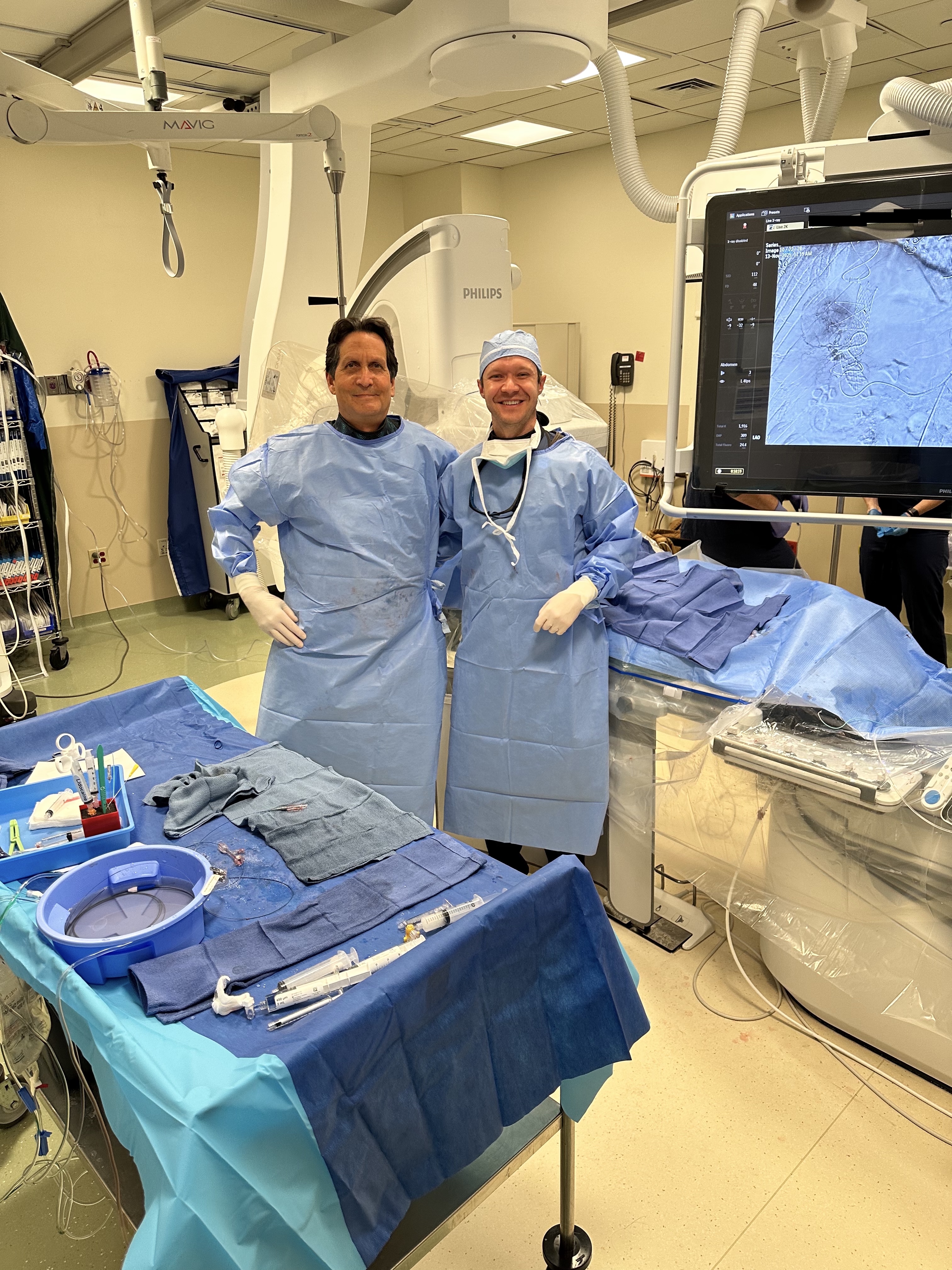
Kyle S. Stumetz, DO, winner of the 2025 CIO Young Investigator Award, recently spoke with Vascular Disease Management about his work on hydrodissection with absorbable gelatin as an alternative to D5W in oncologic thermal ablation. Dr Stumetz is an interventional radiology fellow at Dartmouth Hospital, and the study was conducted along with his mentor and co-author, Eric Hoffer, MD. Click here to watch a video of the interview.
What inspired your team to explore absorbable gelatin as an alternative hydrodissection material, and how does it address the limitations of traditional techniques?
The reason we started using gel foam hydrodissection for some of our ablation cases was basically out of necessity. We had a few cases where D5W didn't create an adequate space or displacement from a vital organ that was in a really confined space. What we found was, when we added gel foam to the mixture and created a more viscous slurry, we were better able to displace the adjacent organ. Additionally, gel foam is a product that all interventional radiologists (IRs) are familiar with. It's easy to prepare and quick to inject and, in the relative cost-conscious health care market, it's very cheap and very inexpensive. So, for those reasons, we have started using it more often, especially when we think there's going to be a small space that's going to be hard to displace.
Does the handling and deployment of absorbable gelatin differ from standard fluid hydrodissection, and should operators expect procedural adjustments or a learning curve?
To be honest, there really isn't much of a learning curve when it comes to using gel foam for hydrodissection compared to many new technologies like conformable embolics, where it acts like something we've never used before. Everyone in IR knows what gel foam’s like, knows how to use it, and knows how it acts. Really, the only problem you sometimes run into is sort of the Goldilocks phenomenon, where you may have to dilute it up or make it thicker just a little bit to fit it perfectly in the space that you're aiming for. But other than that, it's very easy and effective to use.
How does the use of absorbable gelatin compare to other techniques in terms of cost-effectiveness, procedure time, and radiographic visibility during ablation?
Again, I think this is one of the real beauties of using gel foam as a hydrodissection technique: it's extremely cheap, and it honestly ends up being quicker for us than instilling D5W a lot of the time just due to the sheer volume for gel foam we're injecting—20, 40, maybe 80 ccs at most, vs D5W where we're sort of pressure bagging it over a long period of time, maybe 500 ccs or a liter worth of fluid.
In terms of visibility, you have the same sort of benefit where the gel foam is more or less a glob that's sitting right next to you, showing you the edge of the liver or kidney and then the adjacent vital organ vs when you're instilling D5W, it's sort of flowing away and that changes over time. So, I think those are all benefits of using gel foam.
Given your promising early results, in what clinical scenarios—such as challenging hepatic or renal lesions—do you see absorbable gelatin hydrodissection having the most immediate impact?
I think the cases where new users are going to find this really effective is going to be in a really tight space. For us, those spaces tend to be right next to the gallbladder if you can't aspirate it to sort of collapse it enough to create a safe ablation margin, or when you're working on the posterior aspect of the liver, maybe close to the duodenum, which is relatively immobile, or next to the pancreas. While in a renal tumor it's pretty easy to displace the colon with a large volume of fluid, some of those other ones I just mentioned are really tight spaces and you have a really hard time hydrodissecting with just normal saline or D5W. So, I would recommend using those cases as your first cases if you're going to try using gel foam.
Is your team working on any additional studies in this space, and what can we look forward to seeing next from you?
While this small retrospective case series was important for showing the safety and efficacy of using gel foam and ablations, what we're trying to do going forward is standardize our approach and figure out exactly which locations are most beneficial for gel foam hydrodissection, as well as doing direct comparisons between D5W and gel foam hydrodissection to show how the placement of adjacent organs varies between the two. n