Andrews’ (& James’) Diseases of the Skin, 14th Edition
© 2026 HMP Global. All Rights Reserved.
Any views and opinions expressed are those of the author(s) and/or participants and do not necessarily reflect the views, policy, or position of the Dermatology Learning Network or HMP Global, their employees, and affiliates.
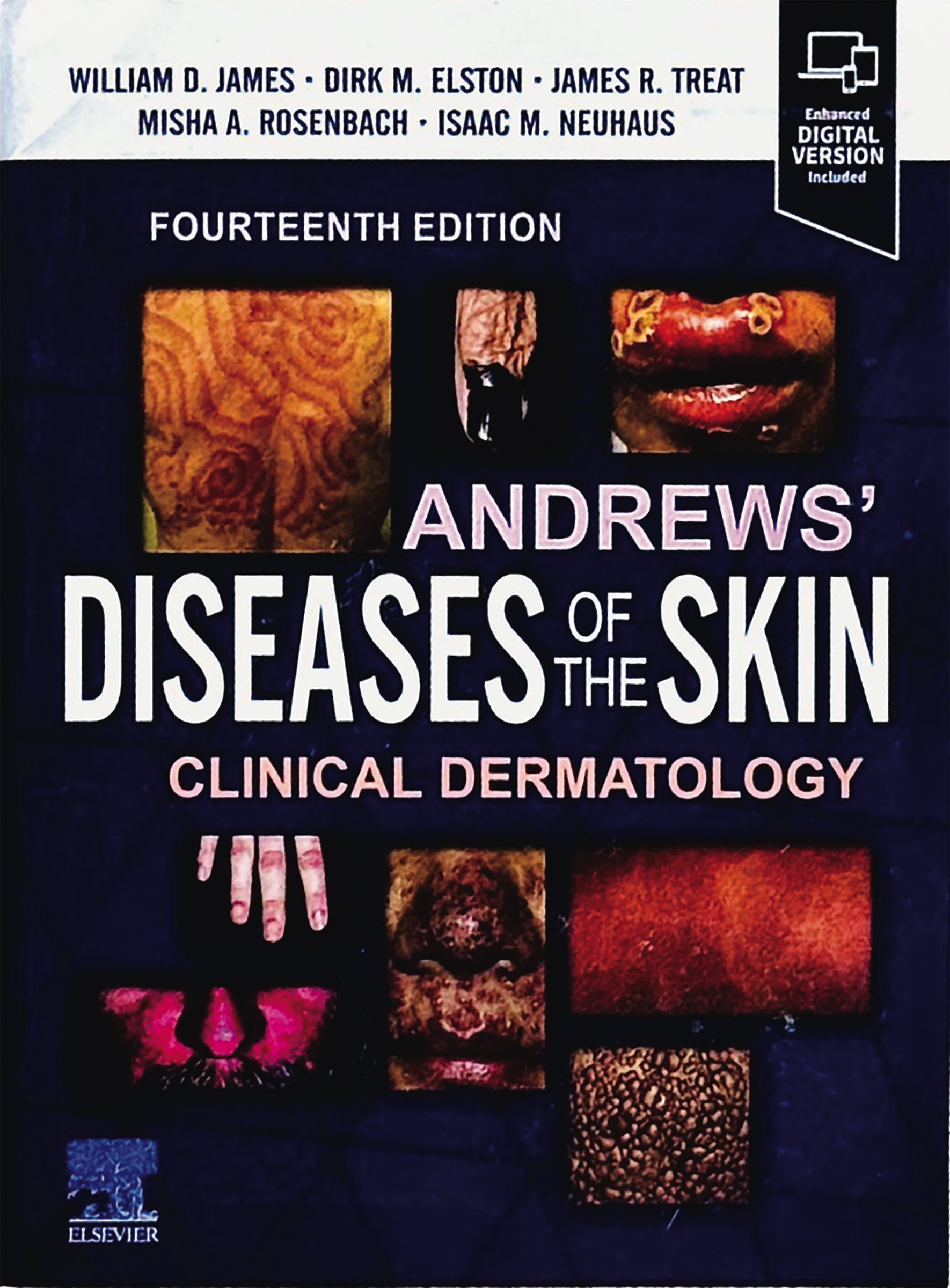 Laid up in bed and recovering from a surgical procedure, I decided to make the most of my downtime and reattack Andrews’ Diseases of the Skin, now in its 14th edition (Elsevier; 2025). It seemed like a worthwhile task to keep me sharp and help me integrate my nearly 20 years of clinical experience. Of course, I am no stranger to this text, and I have been known to consult the current edition while working in clinic. But the last time I “read” Andrews’ as a book rather than a reference was when I was a resident and it was in its 9th edition. Back in the good old days, when all the photos were still in black and white…
Andrews’ is now, as it was then, a compendium of all that is relevant for the practicing dermatologist. Consuming it is analogous to eating a dense flourless chocolate cake. Each pageful (or mouthful, if you will) is rich and to be savored. To get the most out of this daunting exercise, I would clearly need to pace myself. I endeavored to read a few hours a day, which translated to roughly 20 pages a sitting (or rather lying in bed). Clocking in at nearly 1000 pages, you can follow the math to confirm that this exercise took me approximately 7 weeks to complete. And seeing how much time and effort it took me to read, I can only imagine how much time and effort it took to write!
Reading Andrews’ the second time around was a fulfilling experience because I could approach it from an entirely different perspective. For starters, much of the text made intuitive sense to me, and page after page brought back memories of patients who I have seen, puzzled over, and cared for throughout the years. Having a certain amount of clinical context under my belt made the exercise more meaningful. This same context allowed me to feel at ease when reading about topics that I consider to be more esoteric, of which there are many. I felt less pressure to assimilate information; just recognizing it as informative and interesting, and knowing where I could go back to find this information, was plenty sufficient.
Of course, exactly what is and is not considered esoteric is rather subjective and depends on where and how one practices. I recall a conversation I had with a dermatologist from the Philippines quite some years ago at a multi-headed microscope. While looking at slides, he related that leprosy and tuberculosis were an integral part of his practice, yet he had only come across a handful of cases of melanoma in his career. At that time, it was a good reminder that “all epidemiology is local.” And herein lies one of the issues with a big-tent book like Andrews’—how to cover the entire field of dermatology thoroughly. To what extent does a book like this cover a condition such as podoconiosis, a disease of exogenous lymphatic blockage, which is prevented by wearing shoes? Surely the authors have had to make some tough choices. At some point, all the information will not fit in 1 volume.
So how to make space for future new material? A careful reading of the text reveals mild redundancies, which could be additionally tightened. However, with its limited authorship, Andrews’ already benefits from being written rather than curated. And even though Andrews’ is a fully electronic work, and thus theoretically freed from the constraints of space, there is something satisfying about this being a single-volume work light enough to pick up with 1 hand (arm). As one who has been accused of, with regards to books, favoring the “dead tree” edition, I would be in favor of removing the references from the text directly and relegating them to the digital space. To be able to utilize the references as they stand, an electronic device is required anyway, unless you find yourself in a well-endowed academic library. This suggestion alone could free up dozens of pages for future content.
Andrews’ is now accompanied by a stand-alone atlas, Andrews’ Diseases of the Skin Clinical Atlas, 2nd edition, which I referenced while reading the parent text. The additional images presented in the atlas aid and enrich the reader’s experience. And, moreover, Andrews’ Diseases of the Skin, 14th edition comes with an online image database with even more additional photos, although I would be remiss if I did not point out that there are still hundreds of entities with not a single photo to represent them. As a highly visual field, filling in the gaps would add value to future editions.
This current edition largely organizes material in the same way as it did in the 9th edition. With the explosion of genetic and immunologic advances, however, one gets the sense that dermatology is slowly transitioning from a morphologic and histologic to a molecular organization, which I suspect will become more prominent and cogent over upcoming editions. We can already see this emerging with entities that 20 years ago would have been gibberish to most: RASopathies, PTEN hamartomas, PIK3CA-related overgrowth syndromes, BAPomas, etc.
A few other observations are worth making. The authors have impressive expertise in HIV/AIDS and detail repeatedly how this illness can modify skin disease and bring to the fore otherwise uncommon presentations. One wonders if this expertise will continue in the age of highly active antiretroviral therapy.
Revolutionary new drugs have led to an avalanche of adverse drug reactions discussed in the text. Dermato-oncology has clearly increased in prominence, and the adverse effects of checkpoint inhibitors are particularly ubiquitous. Dermatology as a field also appears somewhat traumatized by COVID, with there being many reports of COVID-induced skin disease. Likely time will help clear up what is causal and what is coincidental. Lastly, I could not help noting that on several occasions when the authors point out the possible adverse effects of a variety of immunizations, they courageously stand behind the collective benefits of vaccination, which I find meaningful and timely.
Great texts like Andrews’ don’t just fall out of the sky and thus I think some additional attribution is due. Dr Andrews was a prolific dermatologist in the early 20th century who pioneered the use of tetracycline for acne and authored a 1047-page text to, as he described in the preface of his 1930s 1st edition, “keep my knowledge up to date.” The skeleton structure that he authored more or less remains intact in the latest edition. Gone, however, are the chapters on Roentgen ray (“the most useful and successful single remedy available for the treatment of skin diseases”), supersoft X-ray (Grenz ray), and radium therapy. His discourse on “the gender of commonly used Latin words” today seems quaint, and I am tickled to learn that herpes, cimex, and lichen are masculine, whereas dermatitis, stria, and urticaria remain feminine terms.
Understandably, much has changed in the last century; practice in today’s day and age would be close to unrecognizable to Dr Andrews. In spite of this, Andrews’ Diseases of the Skin has remained current through much revision and updating, and it has benefitted from the collective wisdom of such august authors as Drs Domonkos, Arnold, Odom, James, Berger, Elston, Treat, Rosenbach, and Neuhaus. In particular, Dr William James stands out as the mastermind of Andrews’ and has been associated with it since before I even graduated from high school. His unwavering dedication and leadership make it fitting for me to recommend without hesitation or reservation Andrews’ (& James’) Diseases of the Skin, 14th edition. Approach it 1 bite at a time.
Dr Craig is a clinical dermatologist at Kaiser Permanente in Walnut Creek, CA, and the author of The Itch: Scabies.
Disclosure: The author reports no relevant financial relationships.