Quiver Technique to Reduce Persistent Pixel Scarring After Fractional CO2 Laser
Fractional delivery of carbon dioxide (CO2) laser has dramatically improved the safety and reliability of ablative laser treatments for medical or cosmetic use. In most cases, fractional CO2 laser systems employ software that regulates the delivery of fractal beams in a self-repeating and grid-like pixel pattern. Most modern laser systems allow the clinician to titrate aspects of laser energy and delivery in accordance with treatment parameters and patient-specific criteria.
In theory, the fractal beams delivered within the grid-like pattern create fractional zones of injury that rapidly epithelialize through a normal process of wound healing. It is not uncommon for the micro-injuries to proceed through staged healing processes that exhibit post-inflammatory erythema (PIE) and post-inflammatory hyperpigmentation (PIH). In most cases, the micro-injuries caused by fractional CO2 laser heal with noticeable scarring.
However, a study by Esmat et al. described a subset of patients who sustained prolonged or permanent scarring from fractional CO2 laser.1 The authors described the scars as “persistent pixel stamping marks” (PPSM). PIE, PIH, and even hypopigmentation are possible scenarios that can make these pixelated marks incongruous with normal healing, visible, and unsettling to the patient seeking cosmetic improvement of the skin.
Further, the study examined these pixelated scars through a combination of clinical photography, dermoscopy, optical coherence tomography, and 4-mm punch biopsy, associating them with either microscopic thermal zones or signs of delayed healing. PPSM were found in less than 10% of study participants.
Despite excellent technique, we believe that pixelated scars are inevitable in a subset of patients, particularly in cases of delayed wound healing, inadequate pre-laser skin preparation, previous scarring, and transitional areas of the face that are associated with varying skin depth. In addition to minimizing the incidence of these scars, we propose a unique clinical technique to aid in the randomization and camouflaging of these scars before they occur.
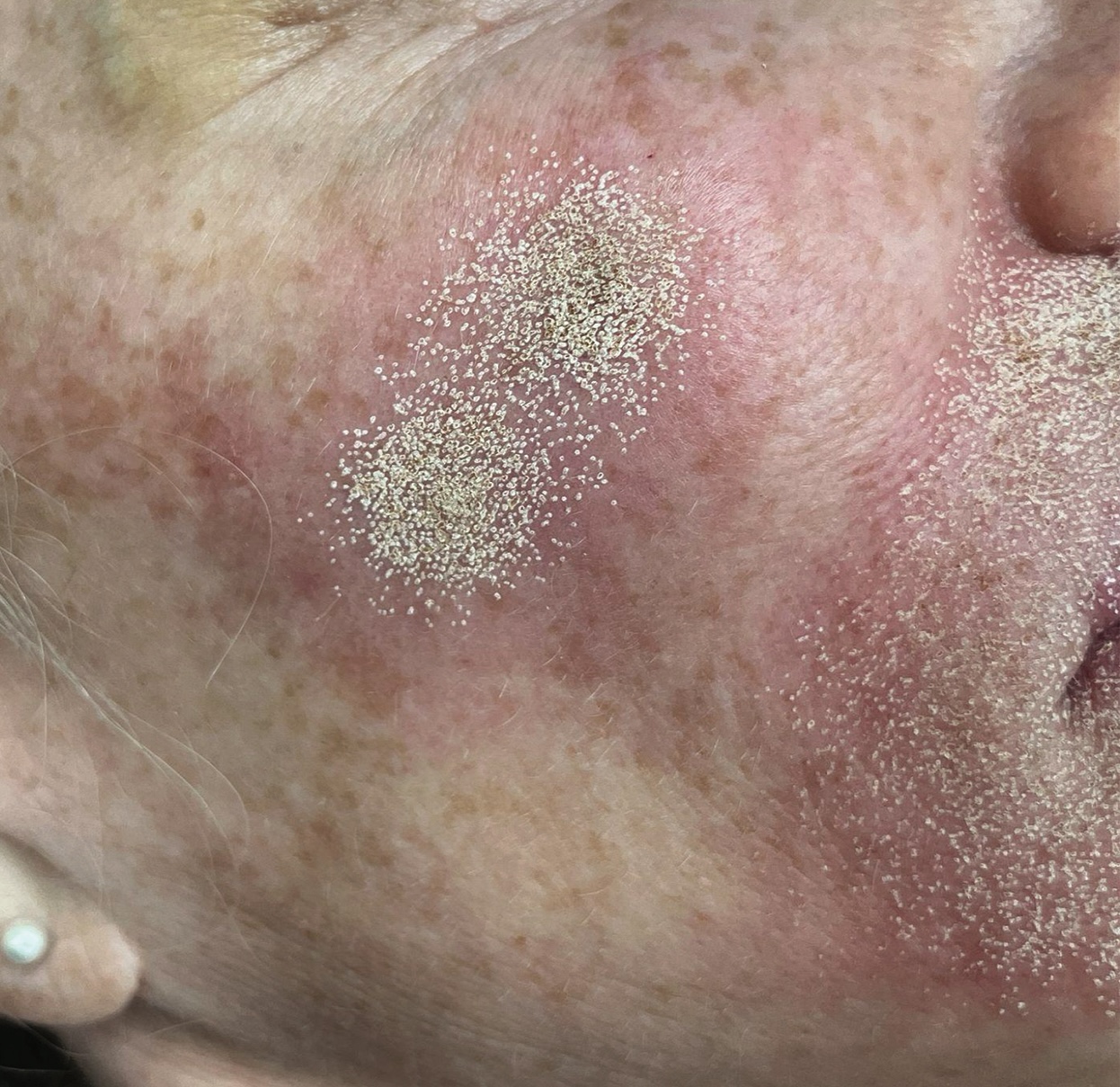
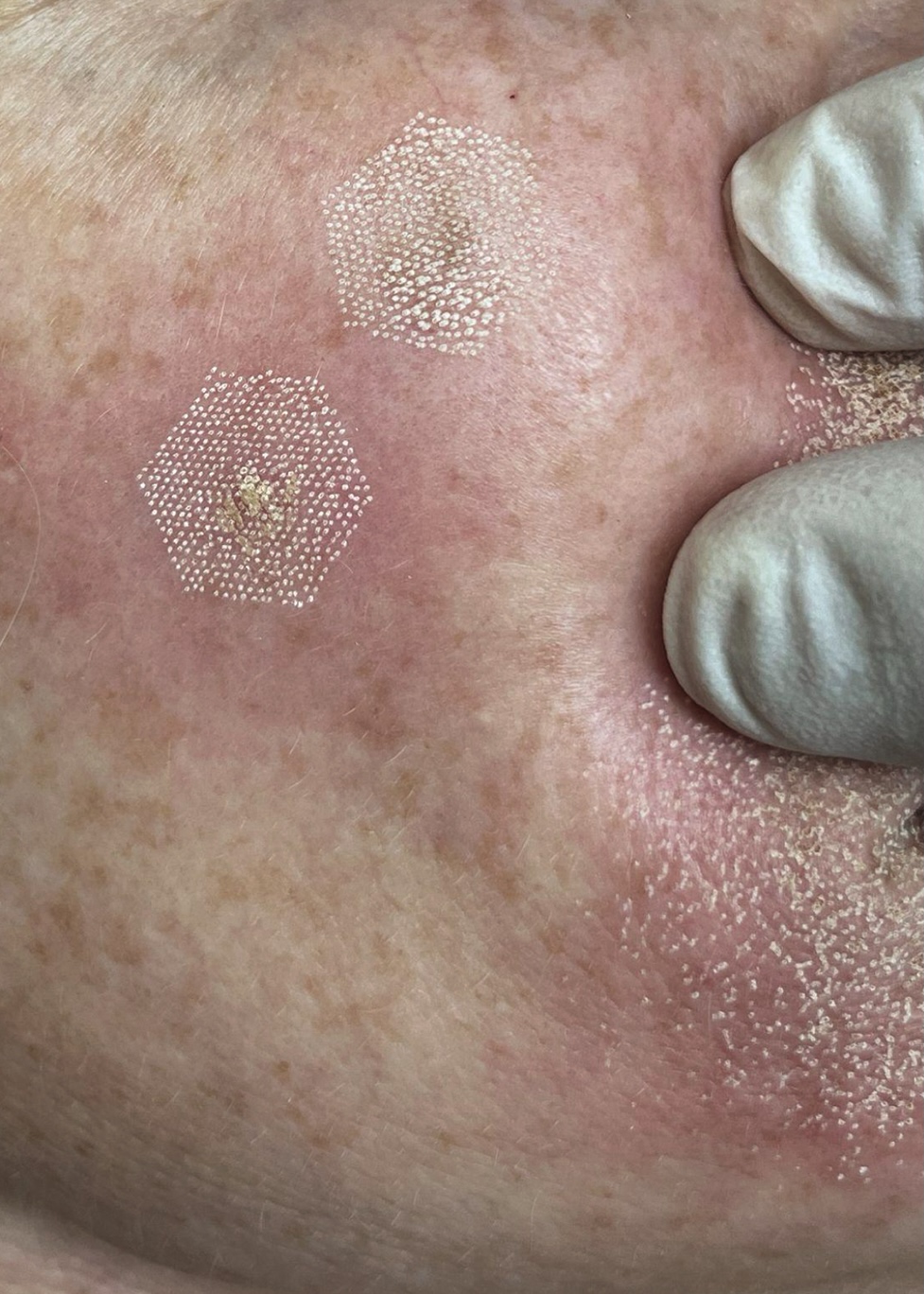
In the authors’ experience, a small subset of patients will exhibit persistent pixelated scars from the fractional CO2 laser. We have found that the orderly and linear grid-like pattern makes these scars difficult to conceal, regardless of the post-treatment technique used. Although most of these persistent PIE and PIH scars resolve, makeup can often do very little to conceal an unnatural-looking grid pattern on the face (Figure 1). We propose, instead, a simple modification of the CO2 laser technique to randomize the pattern of the fractal beams (Figure 2). Rather than keeping the laser handpiece completely still during the entire duration of the CO2 laser macro-pulse, the technique involves moving the handpiece ever so slightly in a quivering motion to create a more randomized pattern of laser beams. This technique converts the square footprint to a more abstract, semi-circular, and nonuniform collection of micro-pulses.
In the event the fractional CO2 laser results in persistent PIE and PIH scars, the authors have found that the temporary scars are more amenable to cover up until they resolve. Certainly, this technique is not without a risk-reward profile, as the alteration often diminishes the reproducibility of fractal beam distribution and may dysregulate density measurements. However, we have found the quiver technique useful in clinical practice to minimize the overall incidence of persistently problematic PIE and PIH after fractional CO2 laser.
Levon Karamanoukian is a student at Brentwood School in Los Angeles, CA, and a research intern for Dr Rtail. Kushagra Tewari is a medical student at the UCLA School of Medicine in Los Angeles, CA. Dr Rtail is a facial plastic surgeon at Saint Joseph Medical Center in Beirut, Lebanon.
Disclosure: The authors report no relevant financial relationships.

Reference
- Esmat SM, Abdel-Halim MRE, Gawdat HI, et al. Persistent pixel stamping marks: a novel complication of fractional CO2 laser in scar treatment. Lasers Med Sci. 2019;34(6):1125-1135. doi:10.1007/s10103-018-02700-5