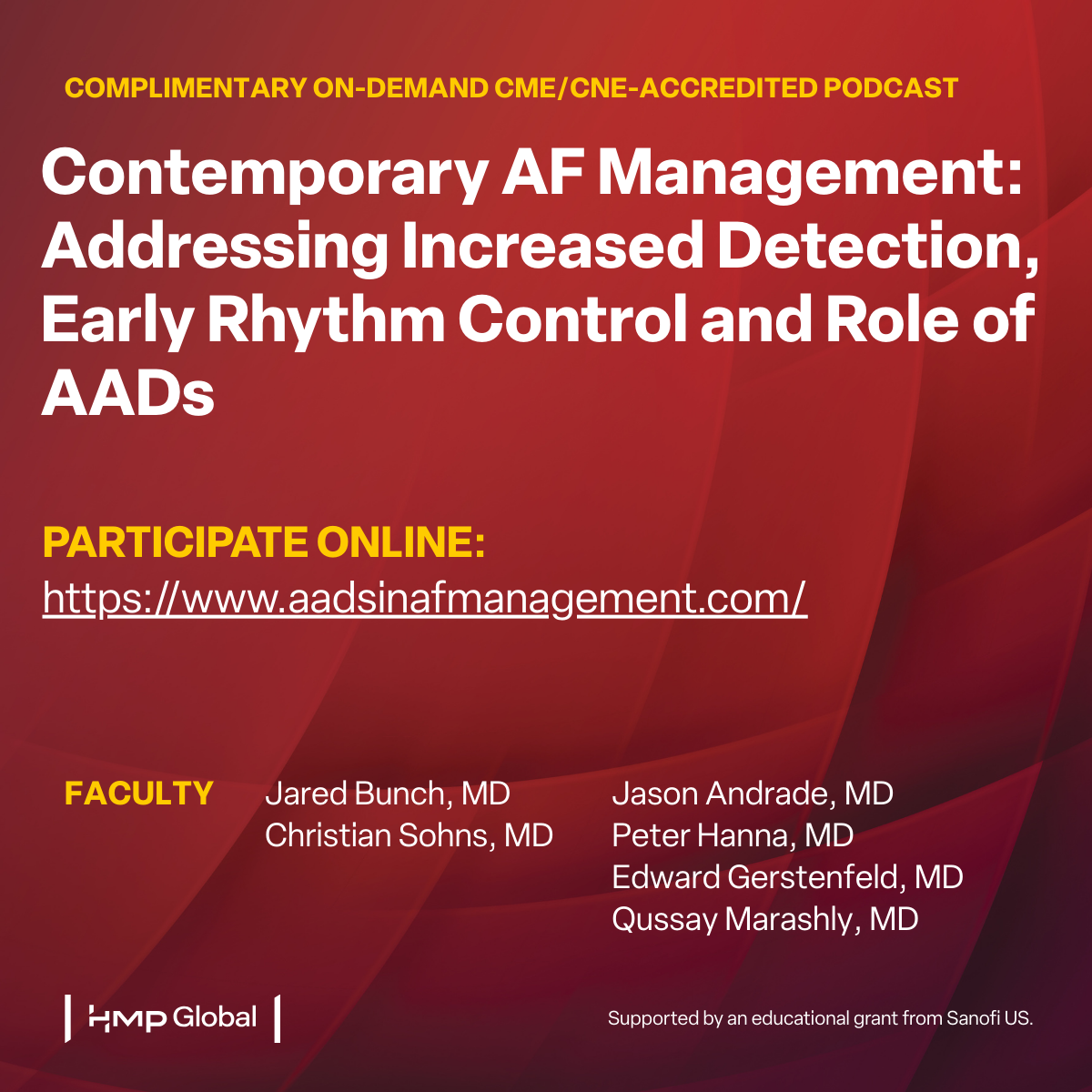
Contemporary AF Management: Addressing Increased Detection, Early Rhythm Control and Role of AADs
© 2026 HMP Global. All Rights Reserved.
Any views and opinions expressed are those of the author(s) and/or participants and do not necessarily reflect the views, policy, or position of EP Lab Digest or HMP Global, their employees, and affiliates.
 Part 1: AF Overview & Artificial Intelligence in AF Care & AF Diagnosis and Initial Management
In this episode, Qussay Marashly, MD, and Peter Hanna, MD, PhD, explore the evolving landscape of atrial fibrillation (AF) care. Dr. Marashly reviews the epidemiology and burden of AF and discusses how artificial intelligence is transforming detection, risk prediction, and treatment selection. Dr. Hanna focuses on practical diagnosis and initial management, including ECG confirmation, stroke risk assessment, and guideline-directed care.
Episode Highlights:
- The growing clinical and population impact of AF
- AI-enabled detection and risk stratification tools
- Identifying high-risk patients
- Accurate diagnosis and evidence-based initial management
This podcast series was originally presented and recorded for CME credit at WAFIB 2026.
Part 2: Antiarrhythmic Therapy & Rate vs Rhythm Control and Personalized AF Treatment Strategies and Questions, Discussion, & Case-Based Application
In this episode, Edward P. Gerstenfeld, MD, MS, and Jason Andrade, MD, explore practical strategies for managing atrial fibrillation (AF), from antiarrhythmic drug therapy to personalized rate and rhythm control approaches. The discussion highlights how to match the right therapy to the right patient, optimize safety, and apply evidence-based strategies in real-world practice.
Episode Highlights:
- Overview of antiarrhythmic drug classes and key safety considerations
- DOAC and AAD combination strategies
- Rate vs rhythm control: evidence and patient selection
- Early rhythm control concepts
- Shared decision-making and individualized AF care
- Case-based insights and expert Q&A
This podcast series was originally presented and recorded for CME credit at WAFIB 2026.