



Timeline and Comparison of Pulsed Field Ablation Systems Available in the United States
© 2026 HMP Global. All Rights Reserved.
Any views and opinions expressed are those of the author(s) and/or participants and do not necessarily reflect the views, policy, or position of EP Lab Digest or HMP Global, their employees, and affiliates.
EP LAB DIGEST. 2026;26(6):5.
Bradley P Knight, MD, FACC, FHRS
Dear Readers,
Pulsed field ablation (PFA) systems have been rapidly and widely adopted in the United States. Despite the higher costs associated with PFA catheters—and the need to acquire expensive new PFA generators and, in some cases, a new 3D mapping system—most electrophysiologists now use PFA for most, if not all, atrial fibrillation (AF) ablation procedures. Since FDA approval of the PulseSelect PFA catheter (Medtronic) in December 2023, 6 different PFA systems have entered the market. The table below compares the currently available PFA catheters and systems.
It has been interesting to see how centers across the US have approached their PFA system selections. In many cases, decisions are centralized when hospitals are part of a larger health network, but several factors appear to influence adoption, including safety and outcomes data, disposable and capital costs, the preferred or existing 3-dimensional mapping system at a given hospital, prior physician experience during IDE clinical trials, peer feedback, case demonstrations at national meetings, hospital contract negotiations, and potential catheter deals to acquire capital.
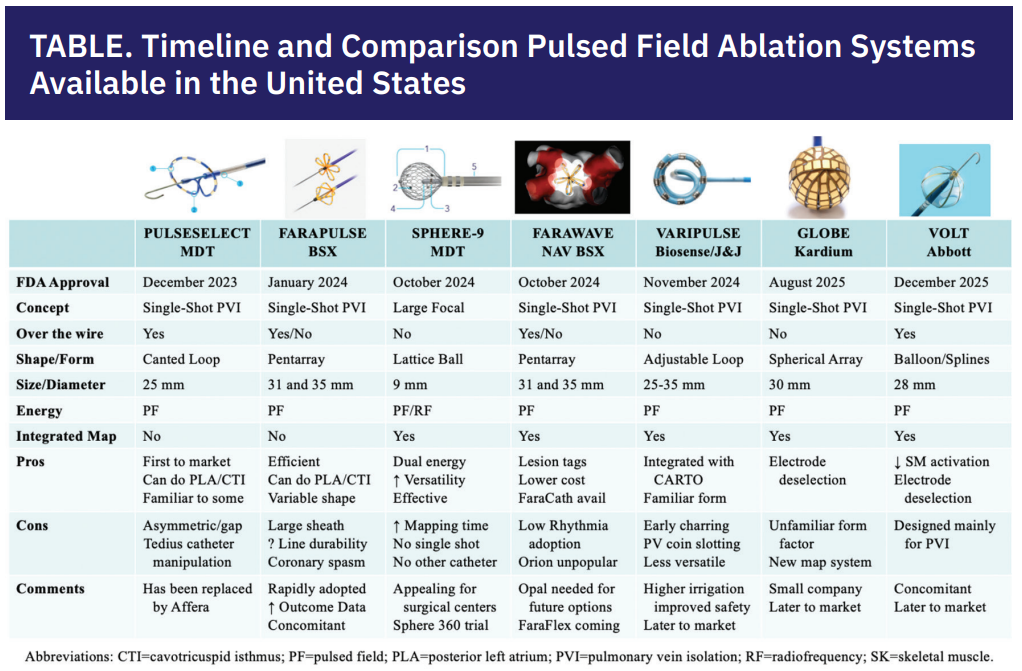
There also appears to be some practice-pattern trends in device adoption. For example, electrophysiologists who had been using point-by-point radiofrequency ablation for AF procedures may be more inclined toward adoption of large focal PFA catheters, such as the Sphere-9 (Medtronic) 9-mm lattice catheter, whereas those who had been using the cryoballoon for pulmonary vein isolation may be more familiar with larger single-shot PFA systems, such as the Farawave (Boston Scientific) 31-mm pentaspline catheter. At the same time, several companies appear to be expanding their portfolios to include both a large-focal and single-shot PFA option.
The US experience with PFA adoption has so far suggested that early market entry may provide a meaningful competitive advantage. More recently approved PFA catheters, such as the Globe (Kardium) and Volt (Abbott) catheters, may face the challenge of entering hospitals that have already invested in one or more PFA platforms.
At the same time, with many additional PFA systems still in development, it will be interesting to see how the field continues to evolve and how emerging technologies differentiate themselves through clinical performance, workflow advantages, or cost considerations relative to currently available systems.
The views expressed are those of the author and do not necessarily reflect those of the publisher or EP Lab Digest.
Disclosures: Dr Knight has served as a paid consultant to Medtronic and was an investigator in the PULSED AF trial. He has served as a consultant, speaker, investigator, and/or has received EP fellowship grant support from Abbott, AltaThera, AtriCure, Baylis Medical, Biosense Webster, Biotronik, Boston Scientific, CVRx, Philips, and Sanofi; he has no equity or ownership in any of these companies. Dr Knight reports payment or honoraria from Convatec for a lecture.