Rethinking Stroke Risk: Matthew Segar, MD, MS, Recognized as One of Two Abstract Award Winners at Western AFib 2026
© 2026 HMP Global. All Rights Reserved.
Any views and opinions expressed are those of the author(s) and/or participants and do not necessarily reflect the views, policy, or position of EP Lab Digest or HMP Global, their employees, and affiliates.
Interview by Jodie Elrod
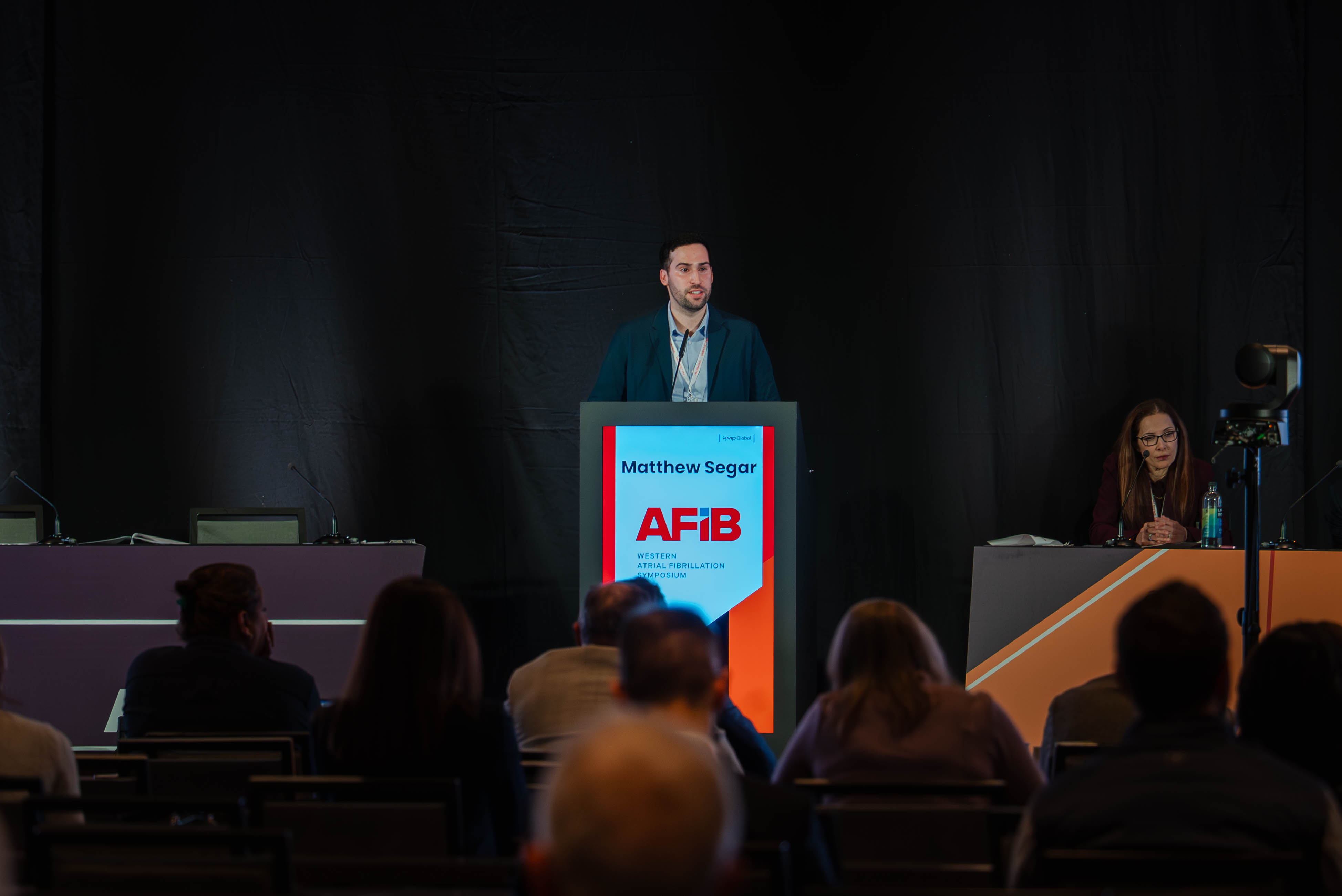 At the 2026 Western Atrial Fibrillation (AFib) Symposium, Matthew Segar, MD, MS, cardiac electrophysiology fellow at the Texas Heart Institute in Houston, Texas, was recognized as one of two abstract award winners for his presentation, “Atrial Cardiomyopathy Drives Stroke Risk Independent of AFib: A Multi-Cohort Analysis.” The abstract winner announcement was made onsite on February 26, 2026, during the exhibit hall opening reception as part of the EP Fellows Research Competition.
In our interview, Dr Segar discusses the clinical implications of his research and reflects on his experience at this year’s meeting.
See our upcoming interview with the other abstract winner, Shohei Kataoka, MD, et al, for their abstract entitled “”Long PR Interval Leads to Worsening Atrial Function and Inducible Atrial Fibrillation in Swine.”
Your research suggests that atrial cardiomyopathy may cause strokes even when AFib has not been detected. How should this change the way we think about preventing stroke?
I think it raises a lot of questions about what we know and do not know about AFib. For the past 2 decades, we have used AF as a proxy for stroke risk. This has worked reasonably well because AFib and atrial substrate disease tend to be comparable. But what we have helped show in this study is they are not the same thing. AFib is a rhythm and atrial cardiomyopathy is a disease of atrial tissue itself (fibrosis, dilation, mechanical dysfunction, impaired conduction). Interestingly, what our study showed is that the majority of strokes in patients with atrial cardiomyopathy happen before AFib is ever detected. For clinicians, I think this causes us to stop and think about potentially missed opportunities where we treat the AFib but do not treat the atrial cardiomyopathy. There are patients who fall in that gap. I want to be clear that I do not think we should immediately anticoagulate every patient with an abnormal electrocardiogram (ECG), but it should raise concern when a clinician observes structure changes such as left atrial (LA) enlargement with electrical abnormalities on ECG (eg, a wide P-wave or abnormal PTFV1). Even if the rhythm strip is normal, these findings can prompt a meaningful conversation about stroke risk.
You identified 4 atrial phenogroups using machine learning. What defined the highest-risk group, and why do those markers signal elevated risk?
What I think is really interesting about Cluster 4 (the group we designated as atrial cardiomyopathy) is that it was qualitatively different than any other cluster. Where Cluster 3 had severe structural disease (dilated LA, elevated NTproBNP, worse blood pressure) alone, Cluster 4 had all of that structural disease plus marked electrical changes. PR intervals were approaching 190 milliseconds, interatrial conduction block was seen in nearly 1 in 5 patients, and this group had the most abnormal P-wave morphology and PTFV1 in the entire cohort.
This is mechanistically important because atrial contraction is not just about rhythm. When the LA is severely dilated and conduction is abnormal (ie, delayed, dyssynchronous LA activation), coordinated and synchronous mechanical function is impaired. As a result, the effective mechanical contraction needed to clear blood from the left atrial appendage (LAA) is diminished. Thus, AF is not required to impair LAA emptying. Blood stasis can occur in sinus rhythm when the atrium is sufficiently dysfunctional both structurally and electrically.
Cluster 4 reflects this phenotype and provides a potential explanation for the markedly higher rates of stroke and AF observed in this group.
What additional evidence or steps would be needed before this definition could guide treatment decisions in everyday practice?
This is an important question, and it is essential to be clear about what we do and do not yet know.
What we do have is a validated, clinically applicable definition that improves stroke discrimination beyond CHA2DS2-VASc alone. The definition was derived in nearly 3400 participants and externally validated in over 11,000. We also have mechanistic data demonstrating that the majority of strokes in these patients occur without prior AF, supporting the concept that the atrial substrate, rather than the rhythm itself, may be the treatment target. Additionally, AtCM remained associated with stroke after adjustment for incident AF as a time-varying covariate and after excluding individuals who developed AF either before or after stroke. Thus, AtCM is not simply predicting future AF; it appears to predict risk beyond AF.
What we do not yet have is a randomized clinical trial demonstrating that treating AtCM as the primary indication for anticoagulation reduces stroke. That is the critical next step. The ARCADIA trial is the closest comparator. It randomized patients with cryptogenic stroke and markers of atrial cardiopathy to apixaban vs aspirin, but the overall results were neutral. Notably, the ARCADIA definition was driven largely by NT-proBNP elevation, a nonspecific biomarker. In contrast, our definition is much more granular and specifically requires the combination of structural and electrical atrial disease.
What was your overall experience at the 2026 Western AFib Symposium, and what makes this meeting meaningful to you?
This was my first time attending Western AFib and my first experience at a highly specialized EP conference. It was a genuinely exceptional experience. I believe this is largely due to the unusually sophisticated audience. The attendees—electrophysiologists and cardiologists deeply engaged in AFib management—elevated the quality and impact of the dialogue.
This was particularly evident during the audience questioning following the fellows’ presentations. The questions were highly nuanced and reflected the depth of expertise in the room. It was clear that we were engaging with professionals who have devoted their careers to this field, resulting in much richer discussions.
Join us for next year’s Western AFib Symposium, taking place February 25-27, 2027, in Salt Lake City, Utah!