Prolonged PR Interval May Promote Atrial Remodeling and Atrial Fibrillation: Insights From Western AFib Symposium Abstract Winner Shohei Kataoka, MD
© 2026 HMP Global. All Rights Reserved.
Any views and opinions expressed are those of the author(s) and/or participants and do not necessarily reflect the views, policy, or position of EP Lab Digest or HMP Global, their employees, and affiliates.
Interview by Jodie Elrod
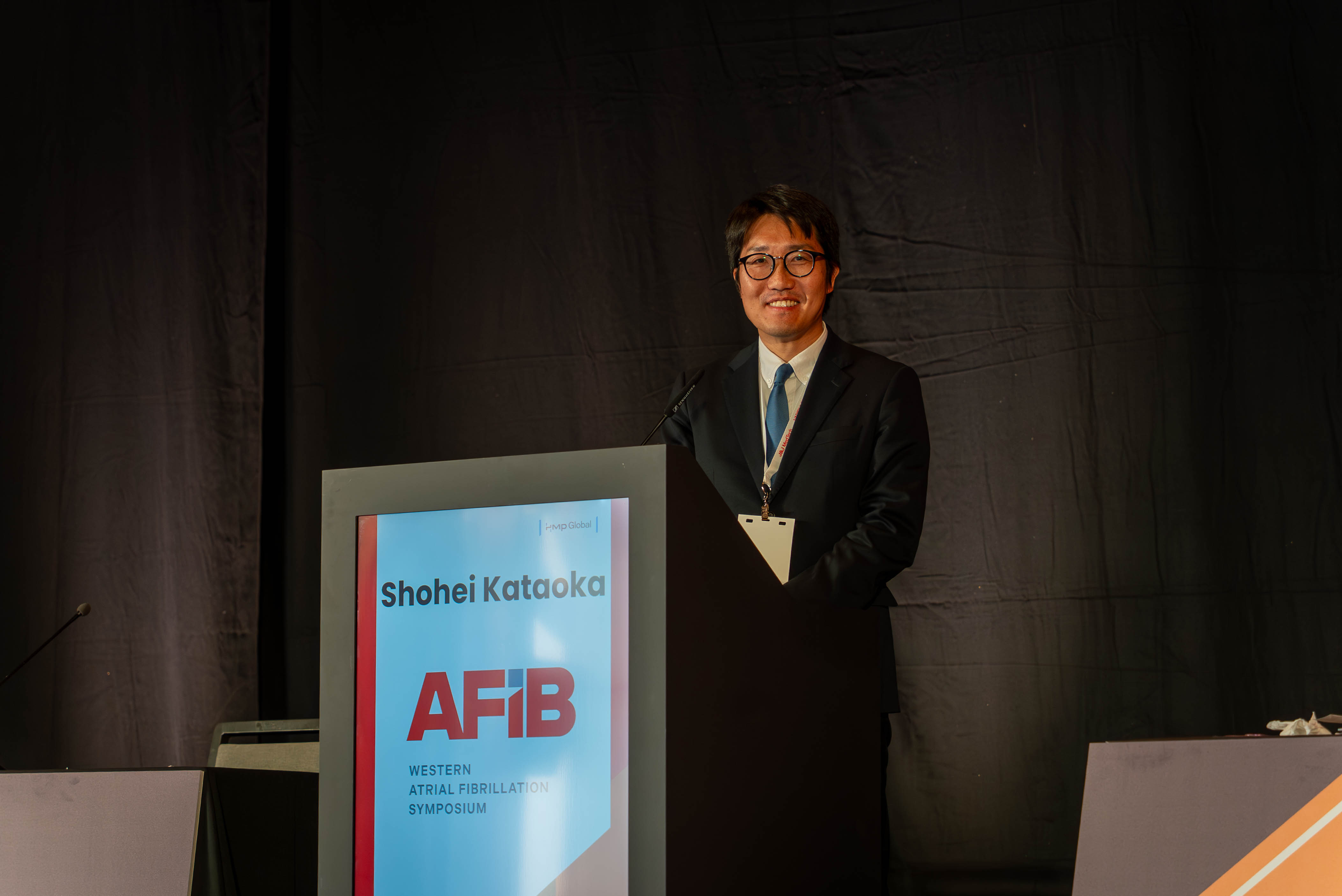
Included here is our interview with abstract winner Shohei Kataoka, MD, et al, for their study, “Long PR Interval Leads to Worsening Atrial Function and Inducible Atrial Fibrillation in Swine,” presented at the 2026 Western Atrial Fibrillation (AFib) Symposium. The abstract was one of two selected for the meeting’s top honors, alongside Matthew Segar, MD, MS, for his presentation, “Atrial Cardiomyopathy Drives Stroke Risk Independent of AFib: A Multi-Cohort Analysis.” The abstract winners were announced onsite on February 26, 2026, during the exhibit hall opening reception.
 Can you briefly describe the background behind your research and what led you to compare intrinsic conduction with a prolonged PR interval versus conduction system pacing (CSP) with a standard AVD?
Pacing therapy is an established treatment for bradycardia, but conventional pacing can cause ventricular dyssynchrony, which increases the risk of heart failure and atrial fibrillation (AFib). To mitigate this, pacing algorithms have been developed to minimize right ventricular pacing. These algorithms reduce ventricular pacing by prolonging the atrioventricular (AV) delay, allowing intrinsic conduction at the expense of a prolonged PR interval. A prolonged PR interval was identified as a risk factor for AFib.
CSP, on the other hand, preserves physiologic ventricular activation through the His–Purkinje system and reduces the risk of pacing-induced cardiomyopathy. Both right ventricular pacing minimization algorithms and CSP are beneficial for preserving ventricular function. However, it remains unclear whether intrinsic conduction with a prolonged PR interval or CSP with a standard AVD is better for atrial mechanics and AFib risk.
We hypothesized that a prolonged AVD allowing intrinsic conduction may promote adverse atrial remodeling compared with a standard AVD with left bundle branch area pacing.
What were the key findings of your study, and what are the main take-home points clinicians should understand regarding atrial remodeling, fibrosis, and AFib inducibility?
We enrolled 24 Yucatan mini-swine divided into 3 groups: a control group (AAI pacing at 90 bpm, n = 8), a standard AVD group (sensed/paced AVD 160/180 ms, n = 8), and a long AVD group (sensed/paced AVD 350 ms, n = 8). Swine in the standard and long AVD groups underwent AV junction ablation after implantation of a dual-chamber pacemaker with left bundle branch area pacing leads. The long AVD group demonstrated adverse atrial remodeling, characterized by worsening left atrial strain and increased atrial dyssynchrony, along with a higher fibrosis burden and greater AFib inducibility compared with the standard AVD group. Overall, these findings suggest that excessive prolongation of the AV delay, even when allowing intrinsic conduction, may promote adverse atrial remodeling and increase vulnerability to AFib.
Based on your results, what do you see as the potential clinical implications—particularly regarding CSP strategies and decisions about allowing intrinsic conduction with a prolonged PR interval?
Right ventricular pacing with pacing minimization algorithms is generally recommended for patients with preserved left ventricular ejection fraction when substantial ventricular pacing is not anticipated. However, in such patients undergoing device implantation, device-detected subclinical AFib is relatively common. Our results suggest that CSP with a standard AVD may be superior to dual-chamber pacing with pacing minimization algorithms in reducing the future incidence of AFib. Approximately 100,000 pacemakers are implanted annually in the United States for sinus node dysfunction. Therefore, CSP with a standard AV delay may help reduce AFib burden in this selected population. Prospective clinical studies in humans are needed to validate these observations and to guide optimal device therapy for reducing new-onset AFib.