Rebuilding Confidence in Alopecia Areata: Multidisciplinary, Holistic Support for Patients and Families
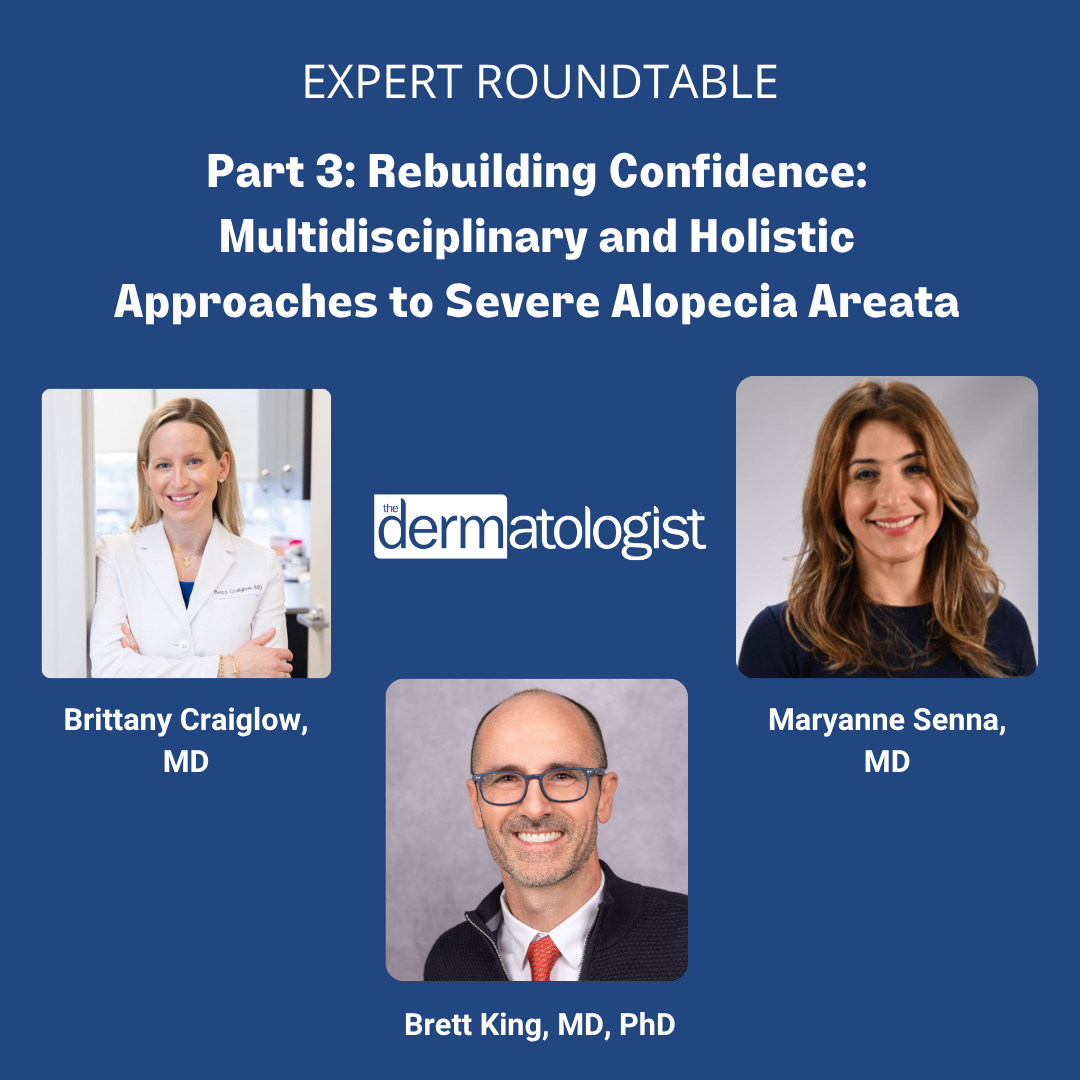 Explore compassionate, whole-person care strategies for alopecia areata in the final part of this roundtable. Dr Brittany Craiglow, Dr Maryanne Senna, and Dr Brett King dive into multidisciplinary and holistic approaches—from peer support and psychosocial care to empowering first-visit conversations and validating patient experiences. Learn how clinicians can move beyond medical therapy to rebuild identity, confidence, and trust.
Dr Craiglow: Now we’re going to move to a section called “Rebuilding Confidence: Multidisciplinary and Holistic Approaches.” The idea is to talk about treating the whole patient—what a clinic visit might look like, what resources are available, and how we can go beyond medical therapy. There’s a lot we can offer.
Maryanne, you mentioned the National Alopecia Areata Foundation (NAAF) already. Do you want to speak a little more about the resources they provide and what that has meant for your patients?
Dr Senna: Absolutely. NAAF has been an incredibly important resource for so many of my patients. Whether it’s their annual patient conference, usually held at the end of June or early July, or their many webinars, there’s so much support. The conference is especially moving. They offer sessions on everything from coping strategies to the latest on therapies, to makeup and wig tutorials.
A highlight for me is the children’s and adolescent camp during the conference, which creates a space for young patients and their parents. It’s such a supportive and loving community. In addition, they offer:
- Webinars to empower individuals with AA and caregivers
- A Doctor Finder to locate dermatologists experienced in treating AA
- Advocacy and insurance tip sheets, including help with coverage for cranial prostheses
They really do a great job covering all aspects of the disease.
Dr King: If I could just jump in. It’s so important for patients to know they’re not alone. That sense of connection is vital. For some, they’re laser-focused on getting their hair back and aren’t interested in anything else. But not everyone will achieve full regrowth, even with JAK inhibitors. Connecting with others who’ve had similar experiences can be deeply helpful for both patients and families.
Dr Craiglow: Right. Some patients may shy away from support groups initially, thinking, “That’s not for me.” But this experience is so unique. Even well-meaning family and friends may not truly get it. It’s incredibly validating for someone to hear their own thoughts reflected back by another person who’s been through it.
Even having just one other person to text when your child gets a question at the playground can make a difference. Local groups, online communities, and the NAAF site all offer varying levels of connection. For those just looking for information, their site is great.
That said, online forums can be a double-edged sword. Patients sometimes come in confused by conflicting opinions about environmental triggers, mold testing, etc. Some of the advice is helpful, but there’s also misinformation.
Dr King: Exactly. And as providers, we can help by validating patients’ experiences. That starts by asking more than just, “Does this bother you?” We have to dig a little deeper to let them feel heard.
But one downside of some online communities is that people may say, “This is who we are, embrace it,” which can be empowering for some but alienating for others. No one should feel pressured into a certain emotional response. It’s our job to help patients feel seen, validated, and supported wherever they are on their journey.
Dr Craiglow: Yes, and it doesn’t have to take long. Even saying, “This is really hard,” or “A lot of my patients feel the same way,” can give people permission to open up. And even when a patient is growing their hair back, it doesn’t mean it’s over. That’s a huge misunderstanding.
This is a traumatic experience. Fear of recurrence is real. Some patients get patches again. And decisions like when to stop wearing a hat or wig are huge. I know in the past I’ve said things like, “You should ditch the wig, you look great with a pixie cut!” But that’s a deeply personal decision, especially for young women growing their hair back unevenly.
Even compliments like “I love your short hair” can feel triggering when that haircut wasn’t your choice.
Maryanne, before we close out, what would you share with clinicians who don’t treat a lot of AA? Any first-visit tips to help build connection and trust?
Dr Senna: Yes! As Brett mentioned earlier, it’s about seeing the patient and validating their experience. Also, in those first visits, patients often ask, “Why did I get this?” or “Do I need bloodwork?” There’s fear that something serious is going on.
So, I always start with a clear explanation: “Alopecia areata is an autoimmune condition. Extensive lab work isn’t usually helpful.” Sometimes I’ll check iron or vitamin D levels, but I explain that improving those won’t necessarily regrow hair.
However, in about 25% to 30% of patients, I do see significant atopic disease—eczema, food allergies, etc. In mild to moderate AA cases, managing those comorbidities can sometimes improve outcomes. For example, a patient with food allergies who isn’t avoiding triggers might not respond as well until those are addressed.
Dr Craiglow: Yes, atopy is common, and sometimes autoimmune thyroid disease, too. But we need to stress that these aren’t the cause. These things run together genetically. Because AA is so visible, patients often feel there must be a trigger, and they’ll link it to a vaccine, an illness, a stressful event.
That’s human nature, but ultimately, we don’t know the “why.” It just happens, just like type 1 diabetes or psoriasis. It’s hard to accept that, but shifting the focus from “Why did this happen?” to “What can we do about it?” is key.
Dr Craiglow (closing): We’ve covered so much. It really is an exciting time for alopecia areata. There’s hope now, and this is a meaningful and rewarding disease to treat. The relationships are long-term, and it reminds me why we all went into medicine.
Dr King: I couldn’t agree more. We don’t have to be afraid when we see a patient with no hair on our schedule. We now have effective treatments, and it’s so fulfilling to watch our patients get better. What’s happening in AA reflects the bench-to-bedside transformation in medicine, and I hope everyone feels empowered to be part of it.
Dr Craiglow: Thank you both. This has been a great discussion. I hope viewers walk away feeling more confident and excited about treating patients with alopecia areata.