LEO Science & Tech Hub (The Hub), a research and development unit of LEO Pharma, has initiated 2 collaborative projects with The Wellman Center for Photomedicine at Massachusetts General Hospital.
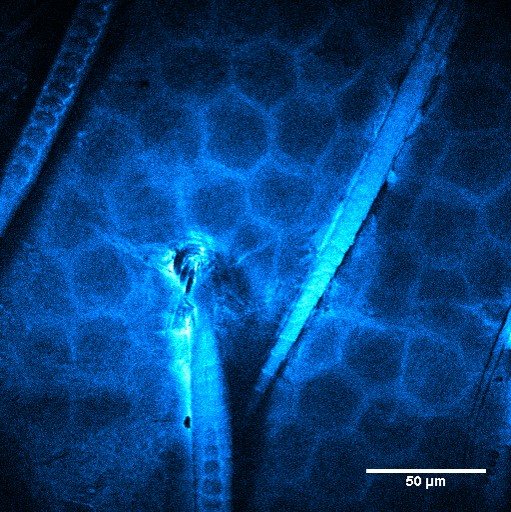
The Hub, which identifies, develops, and funds innovative solutions that improve the lives of patients with skin diseases, will provide research funding to support development of novel imaging technology using a disposable microbiopsy device. Conor L Evans, PhD, assistant professor, Harvard Medical School, will lead the project. The Evans Lab’s specializes in microscopy and spectroscopy for understanding cancer and dermatology disorders. The research project collaboration will explore novel imagine technologies that will to enable non-invasive, high-resolution, real-time pharmacokinetic/pharmacodynamic measurements with help of the lab’s coherent Raman scattering (CRS) technology (Figure 1).
Figure 1. Coherent Raman imaging may one day allow real-time biological measurements to benefit patients. Here’s an image of mouse skin “tuned” into the vibrational frequencies of lipids taken at the surface of skin and shows hairs and the hexagonally packed corneocytes.
The second project includes work with Walfre Franco, PhD, clinical instructor, and Adam Raff, MD, PhD, clinical associate from R Rox Anderson’s Lab. The Anderson Lab will focus on discovering new optical treatments and diagnostics for dermatologic applications, and will seek to develop a suture-free and disposable microbiopsy device that may allow for a non-scarring sampling procedure of full-thickness skin microbiopsies.
"We are excited to enter these collaborations with the Wellman Center for Photomedicine at Mass General Hospital and are honored to work with scientists at the forefront of imaging technology and microbiopsy research,” said Michael Sierra, PhD, VP, The Hub. “At LEO Science & Tech Hub, we firmly believe in the power of collective effort and are always seeking cutting-edge technologies to advance non-invasive biopsy and imaging technologies for patients with skin diseases.”
—Julie Gould (Mazurkiewicz)
LEO Science & Tech Hub (The Hub), a research and development unit of LEO Pharma, has initiated 2 collaborative projects with The Wellman Center for Photomedicine at Massachusetts General Hospital.
The Hub, which identifies, develops, and funds innovative solutions that improve the lives of patients with skin diseases, will provide research funding to support development of novel imaging technology using a disposable microbiopsy device. Conor L Evans, PhD, assistant professor, Harvard Medical School, will lead the project. The Evans Lab’s specializes in microscopy and spectroscopy for understanding cancer and dermatology disorders. The research project collaboration will explore novel imagine technologies that will to enable non-invasive, high-resolution, real-time pharmacokinetic/pharmacodynamic measurements with help of the lab’s coherent Raman scattering (CRS) technology (Figure 1).
Figure 1. Coherent Raman imaging may one day allow real-time biological measurements to benefit patients. Here’s an image of mouse skin “tuned” into the vibrational frequencies of lipids taken at the surface of skin and shows hairs and the hexagonally packed corneocytes.
The second project includes work with Walfre Franco, PhD, clinical instructor, and Adam Raff, MD, PhD, clinical associate from R Rox Anderson’s Lab. The Anderson Lab will focus on discovering new optical treatments and diagnostics for dermatologic applications, and will seek to develop a suture-free and disposable microbiopsy device that may allow for a non-scarring sampling procedure of full-thickness skin microbiopsies.
"We are excited to enter these collaborations with the Wellman Center for Photomedicine at Mass General Hospital and are honored to work with scientists at the forefront of imaging technology and microbiopsy research,” said Michael Sierra, PhD, VP, The Hub. “At LEO Science & Tech Hub, we firmly believe in the power of collective effort and are always seeking cutting-edge technologies to advance non-invasive biopsy and imaging technologies for patients with skin diseases.”
—Julie Gould (Mazurkiewicz)
LEO Science & Tech Hub (The Hub), a research and development unit of LEO Pharma, has initiated 2 collaborative projects with The Wellman Center for Photomedicine at Massachusetts General Hospital.
The Hub, which identifies, develops, and funds innovative solutions that improve the lives of patients with skin diseases, will provide research funding to support development of novel imaging technology using a disposable microbiopsy device. Conor L Evans, PhD, assistant professor, Harvard Medical School, will lead the project. The Evans Lab’s specializes in microscopy and spectroscopy for understanding cancer and dermatology disorders. The research project collaboration will explore novel imagine technologies that will to enable non-invasive, high-resolution, real-time pharmacokinetic/pharmacodynamic measurements with help of the lab’s coherent Raman scattering (CRS) technology (Figure 1).
Figure 1. Coherent Raman imaging may one day allow real-time biological measurements to benefit patients. Here’s an image of mouse skin “tuned” into the vibrational frequencies of lipids taken at the surface of skin and shows hairs and the hexagonally packed corneocytes.
The second project includes work with Walfre Franco, PhD, clinical instructor, and Adam Raff, MD, PhD, clinical associate from R Rox Anderson’s Lab. The Anderson Lab will focus on discovering new optical treatments and diagnostics for dermatologic applications, and will seek to develop a suture-free and disposable microbiopsy device that may allow for a non-scarring sampling procedure of full-thickness skin microbiopsies.
"We are excited to enter these collaborations with the Wellman Center for Photomedicine at Mass General Hospital and are honored to work with scientists at the forefront of imaging technology and microbiopsy research,” said Michael Sierra, PhD, VP, The Hub. “At LEO Science & Tech Hub, we firmly believe in the power of collective effort and are always seeking cutting-edge technologies to advance non-invasive biopsy and imaging technologies for patients with skin diseases.”
In collaboration with Regeneron’s Let’s Get Real About Skin Cancer program, a panel of distinguished dermatologists and oncologists delve into the critical importance of a multidisciplinary care team (MDT) for advanced cases of non-melanoma...
In collaboration with Regeneron’s Let’s Get Real About Skin Cancer program, a panel of distinguished dermatologists and oncologists delve into the critical importance of a multidisciplinary care team (MDT) for advanced cases of non-melanoma...
In a presentation showcased at the Revolutionizing Atopic Dermatitis (RAD) June 2024 meeting, a study evaluated the efficacy and safety of 1.5% ruxolitinib cream in treating AD in face/neck.
In a presentation showcased at the Revolutionizing Atopic Dermatitis (RAD) June 2024 meeting, a study evaluated the efficacy and safety of 1.5% ruxolitinib cream in treating AD in face/neck.
A literature review was conducted to explore recent studies focusing on diagnostic approaches and treatment options for nail psoriasis and nail lichen planus.
A literature review was conducted to explore recent studies focusing on diagnostic approaches and treatment options for nail psoriasis and nail lichen planus.
Test your expertise in identifying risk factors for persistent pediatric atopic dermatitis and understanding the interplay between barrier dysfunction and immune dysregulation.
Test your expertise in identifying risk factors for persistent pediatric atopic dermatitis and understanding the interplay between barrier dysfunction and immune dysregulation.
Assess advanced clinical reasoning in pediatric atopic dermatitis, including implications of type 2 inflammation for diagnosis, treatment timing, and systemic therapy decisions.
Assess advanced clinical reasoning in pediatric atopic dermatitis, including implications of type 2 inflammation for diagnosis, treatment timing, and systemic therapy decisions.
Challenge your understanding of direct and indirect cytokine–nerve interactions and mechanical hypersensitivity of type 2 signaling in prurigo nodularis.
Challenge your understanding of direct and indirect cytokine–nerve interactions and mechanical hypersensitivity of type 2 signaling in prurigo nodularis.
How should clinicians redefine severe alopecia areata? When is it appropriate to treat ≤20% scalp involvement with oral JAK inhibitors? This expert-level quiz explores remission durability, treatment withdrawal, and practical strategies for...
How should clinicians redefine severe alopecia areata? When is it appropriate to treat ≤20% scalp involvement with oral JAK inhibitors? This expert-level quiz explores remission durability, treatment withdrawal, and practical strategies for...
Explore the relationship between allergic disease trends, genetic timelines, and the clinical framework used to describe the progression of atopic conditions across childhood.
Explore the relationship between allergic disease trends, genetic timelines, and the clinical framework used to describe the progression of atopic conditions across childhood.
Assess your understanding of early skin barrier interventions in infants and the clinical rationale for prompt treatment of atopic dermatitis in young children, including implications for long-term disease outcomes.
Assess your understanding of early skin barrier interventions in infants and the clinical rationale for prompt treatment of atopic dermatitis in young children, including implications for long-term disease outcomes.