Your Captain Speaking: When Your Patient Packs Heat
Samantha, I've been hearing more stories from the field about EMS crews running into patients who are armed. With concealed carry and constitutional carry laws expanding across the country, it's not uncommon anymore. But what happens when you're treating someone and discover a firearm? It can turn a routine call into a high-stakes situation. How do we handle that without compromising safety or care?
In my days flying planes, we had procedures for everything—emergencies, routine ops, you name it. EMS isn't much different; preparation is key. Today, let's talk about an update to the EMSWorld article When Your Patient Has a Gun (April 7, 2017). It's a topic that demands respect and protocol. We'll cover the essentials: why written procedures must be crafted carefully, how to safely secure a gun if needed, where to stash it in the rig, securing it back at a residence, and even the right words to ask without ruffling feathers. Buckle up; this is about keeping everyone safe while delivering top-notch care.
Create Solid Procedures
No EMS agency worth its salt operates without solid written procedures for handling firearms. Think of it like aviation's standard operating procedures (SOPs)—they're your lifeline when things get dicey. Every department or ambulance service should have a clear policy prohibiting EMS personnel from carrying firearms themselves, to avoid a patient taking the weapon from you (retention). Intense specific firearm retention training is required—not just having a concealed carry license. I carried a firearm as a federal officer on commercial airplanes for many years following 9-11 and retention of the firearm was a critical item. That said, I wouldn’t want to carry a firearm in the confined space of an ambulance. As EMTs or firefighters, we are not viewed as a threat to some patients compared to uniformed law enforcement officers (LEOs).
Next, every emergency department we can think of has a policy that prohibits anyone, other than LEOs, from entering the ED with a firearm or a knife. Samantha and I would bet a lot of you in EMS carry a folding pocket knife with you as your standard kit when you work. Are you taking it off before you enter the ED? I’ll admit I didn’t even think about it as a problem, but that’s on me. Do your written SOPs address this?
The policy for patients needs to outline steps for discovery, removal, storage, and handover. For instance, protocols should emphasize involving law enforcement early, if possible, especially on scenes that feel "off." I found two agencies that have guidelines that stress allowing patients (if conscious and legal) to hand off their weapon to a trusted person or secure it themselves before transport. I wouldn’t have the patient hand me the pistol for me to hand to someone else. No way. The other person might not be legally allowed to possess the firearm and might not have a clue how to handle it. Without these SOPs in writing, you're flying blind, and that invites liability, injury, or worse. I recommend annual training reviews, scenario drills, and coordination with local police department. Remember, the goal is de-escalation and safety—yours, the patient's, and the public's.
Discovery
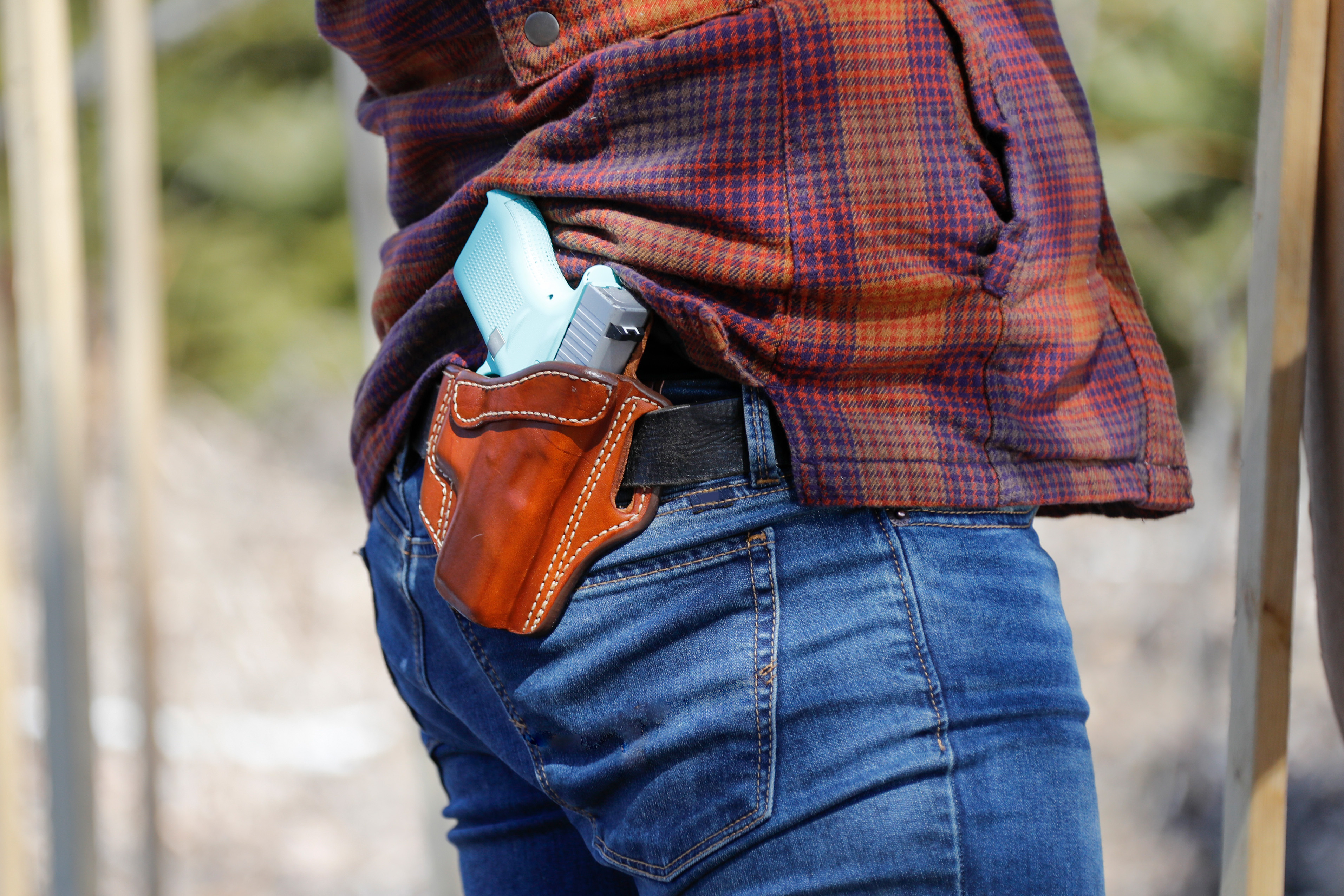
How do we even broach the question at a scene? Asking about weapons can feel awkward or accusatory. Diplomacy and directness win the day. Frame it around safety for all. During initial assessment, after BSI and scene safe, slip it in naturally: "To keep everyone safe while we help you, do you have any weapons, sharp objects, or anything that could hurt us?" Or, "For our mutual safety, are you carrying any firearms or knives today?" You can even ask again before transport, “The hospital doesn’t allow any knives or firearms. Do you have anything like that with you?” Women are more likely to use a purse or bag to carry a pistol so the phrasing “with you” is better than “on your person.”
Keep it neutral and non-judgmental—like asking about allergies. In high-risk areas, make it routine in your head-to-toe: pat down politely with consent, explaining, "I'm checking for anything that might poke or hurt us during movement." If they're altered, search thoroughly but respectfully. Training on phrasing helps—agencies should role-play it. Remember, it's not about suspicion; it's about prevention.
Now you're on a call, and during your assessment, you spot a holster or feel a lump that turns out to be a pistol. How do you safely remove it without turning the scene into a Wild West showdown? There are lots of different types of holsters and firearms. Holsters have different types of mechanisms for weapon retention. Here’s an excellent way to learn about holsters and pistols: Go to a firearm store, explain you are in EMS and want to see how different holsters are designed and how to remove a pistol safely. I regularly did this with motorcycle helmets to learn the tricks of removal. My experience, the staff will be thrilled to show you.
Removing and Securing the Firearm
Before you even touch it, conduct a thorough scene size-up. Is the patient altered? Agitated? Are there bystanders? If law enforcement is already there, ask them to secure it. Assuming it's safe to proceed, communicate clearly with the patient. If they're conscious, ask permission: "For everyone's safety, may I secure your firearm while we treat you?" Get their buy-in; it reduces tension.
DO NOT HAVE THE PATIENT REMOVE THE FIREARM.
You might encounter a patient who knows exactly what to do and how to do it, or one who's clueless and ends up pointing the business end of the pistol at you with a finger on the trigger “accidentally.” You just don’t know at the start.
Are you wearing gloves? You don’t need your fingerprints showing up on a gun that was later connected to a crime.
A pistol in a holster is very safe since the trigger is covered. Remove the holster and pistol as a single unit. A belt might need to be undone; at worst, the belt will need to be cut on both sides of the holster.
Some pistols are carried in a pocket inside a holster; this can be much harder. If a right-hand pocket, use your right hand. Keep your index finger straight as you pull back. If you are unsure, use your EMS scissors to open the pocket so you can see what you are doing. Point the muzzle in a safe direction—away from people, preferably down or toward an exterior baseboard or wall if indoors. In my experience, if the firearm is not in a holster (just tucked into the waistband), it’s most likely not being legally carried.
Remember basic firearm safety. Always treat every firearm as loaded and ready to fire. That's rule No. 1 from any gun safety primer, and it applies double in EMS. Keep your finger off the trigger—religiously. Personally, when I pick up a gun off a table, for example, I point my finger with a closed fist and put my index finger on the slide (or the cylinder of a revolver), then open my other fingers to grasp the grip of the weapon. Keep the firearm pointed in a safe direction. Use your smartphone to practice on right now! Don’t point it at any of your own body parts or anyone else.
Make sure your policy includes this key aspect of firearm safety:
NEVER ATTEMPT TO UNLOAD A FIREARM IN THE HOUSE, FIELD, OR THE BACK OF AN AMBULANCE.
Why? First, there are hundreds of different types of pistols, and you may never have seen it before. There are lots of trips and slips that can happen. It’s just not safe. Police forces and the military use a “clearing barrel,” which is a metal container with sand or ballistic material to catch a bullet in case it’s negligently discharged during loading or unloading. Ambulances don’t have these; EMS doesn’t have the training. There is no “safe” direction to point a firearm to unload in the back of an ambulance. There’s a word for it: negligent discharge. Ask a LEO whether their department ever had a firearm go off in a clearing barrel, and I’ll bet the answer is universally yes. Treat the firearm as deadly and loaded. Keep your finger off the trigger. Never get “cute” by wrapping the firearm in 4-inch tape either.
Extreme caution is the name of the game; one negligent discharge can end careers—and lives. If you're not comfortable in securing a firearm, stage outside and wait for backup. Training is crucial—agencies should offer firearms familiarization courses.
Once you've got it off the patient, where does it go in the ambulance? We can't just toss it in the glove box.
Samantha: The ambulance isn't a gun safe, but it needs to function like one temporarily. Most protocols call for securing the firearm in a locked compartment, away from patient access and out of sight.
A dedicated lockbox in the cab or a secured cabinet in the patient compartment is the best place—some rigs have them for valuables or evidence. If no lockbox, use a locked drug cabinet or even the driver's side compartment, but document it, chain-of-custody style. Notify dispatch and the receiving hospital during pre-arrival report: "We have a secured firearm on board. Request police to meet us at the hospital." Notice I didn’t say hospital security. Upon arrival, hand it off to law enforcement—never leave it unattended.
Note to self: The storage box in the ambulance needs to be big enough to accommodate a full-size pistol, inside a holster, and an extra magazine (or two). It might even have flashlight attached. A small flat pistol case will not do.
What if the call is at a residence? Do we just leave the gun there, or secure it somehow?
Residences add layers. If the patient's home and conscious, let them or a family member secure it—lock it in a safe, in a drawer, or with a responsible adult on scene. Under no circumstances should you let them leave it on a table—think children coming home later.
If the patient refuses to surrender the firearm, your choices are simple: follow your SOPs, and call the police. If no one's around or the patient's altered, don't leave it accessible—kids or visitors could find it. Always prioritize scene safety; if the gun is a threat, back out and stage. In crisis situations, such as mental health calls, remind folks about secure storage to prevent future incidents. Documentation is key: Note where it was found, how secured, and who took custody. This protects you legally and ensures follow-up.
Samantha: Wise words. Wrapping up, what's the big takeaway?
Respect firearms. Follow protocol, and train relentlessly. Firearms in EMS are a reality, but with preparation, we can mitigate risks. Discuss with your partner. Stay safe out there—your captain's orders.
About the Authors
Dick Blanchet, (Retired) BS, MBA, worked as a paramedic for Abbott EMS in St. Louis, MO, and Illinois for more than 22 years. After 9-11, he was a Federal Flight Deck Officer (FFDO) for over 11 years as a LEO and carried a firearm when flying. As a captain with Atlas Air for 22 years on the Boeing 747, he accumulated more than 21,000 flight hours. A USAF pilot for 22 years, he flew the C-9 Nightingale Aeromedical aircraft. A USAF Academy graduate with a Bachelor of Science degree, his Masters in Business Administration is from Golden Gate University.
Samantha Greene is a paramedic and field training officer for the Illinois Department of Public Health Region IV Southwestern Illinois EMS system, a paramedic and FTO for Columbia (Ill.) EMS, and works full time at the St. Louis South City Hospital Emergency Department as a paramedic. She was recently recognized as a GMR Star of Life.