EMS World Expo 2025: What EMS Clinicians Should Know About Artificial Intelligence

Kristopher Thompson doesn’t think artificial intelligence (AI) robots will take over the world, but even he admits that “AI is here to stay” and will have an increasingly influential role in EMS. That’s what he told the audience at EMS World 2025 in his session entitled “What’s Artificial About Intelligence? A Skeptic’s Guide to AI in EMS.”
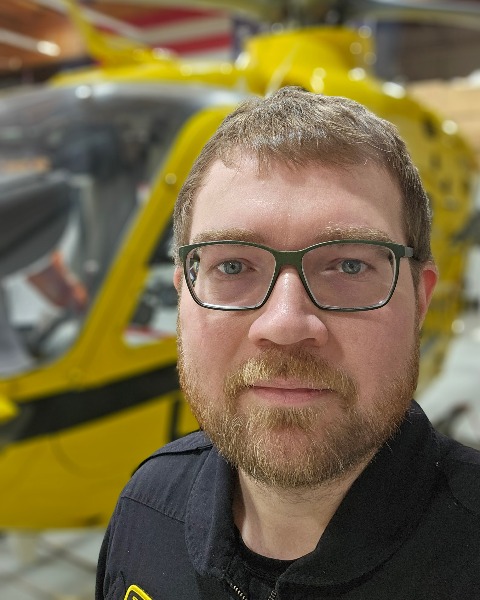
Thompson described some of the innovative ways AI is being used now and will be used in the future to help EMS clinicians do their jobs. He discussed how AI will change emergency telecommunications, including ways it’s already being used to help recognize time-sensitive emergencies faster.
Studies showed the AI algorithms could recognize cardiac arrest faster than people handling the calls, Thompson said, but real-life telecommunicators are still needed to offer the caller support, catch details that the algorithm can’t, and help ensure that false positives don’t strain the system. Other possible uses of AI in communications include automated callbacks to 9-1-1 hang-ups, translation services, identifying and triaging multiple calls for the same incident, and more.
He also described other clinical uses, from helping clinicians identify concerning findings on ultrasound to improving recognition of acute MIs on EKGs. In addition, one way AI is being used more and more in emergency medicine and now in EMS in some areas is with documentation—by simply “listening” to the clinicians’ interactions with each other and the patient, the computer is writing a first draft of a patient care report—freeing up the clinician to not worry as much about documenting in real-time. Finally, he discussed the use of AI to conduct biosurveillance—for example, by noticing an increase in respiratory emergencies or other concerning patterns in dispatch or patient care data.
Despite all these possibilities, Thompson calls himself a “skeptic” because he doesn’t think AI will be able to perform many of the functions of EMS clinicians or other people and will always need humans to serve as guardrails for the technology, to perform certain tasks or procedures, and to connect with the patient in ways computers can’t.
“AI doesn't replace people. It cannot critically think, it cannot emote. It can't, for some part, it can't innovate, it can't advocate for the patients in the way a real person does,” he said. “And I think that's the part I'm skeptical about.”
Challenges of Adoption
Thompson laid out some of the challenges still facing broad adoption of AI technologies in EMS. A significant one could be EMS data. While the collection of patient and response information has improved dramatically in recent years, EMS data often remains incomplete “and probably not all accurate,” Thompson worries. And if the data to train AI on isn’t great, then the AI won’t be either.
There are also concerns about regulatory and legal issues, many of which remain unresolved for AI generally, not just in healthcare and EMS. For example, Thompson asked, who would be liable if AI software in the dispatch center failed to recognize a cardiac arrest? He also brought up the question of usability, and whether AI platforms could potentially distract from, rather than improve, the EMS clinician’s ability to focus on the patient; whether clinicians and patients would trust AI technologies; and how it might impact clinician autonomy.
Finally, Thompson talked about the Gartner Hype Cycle, which is a graphical way of thinking about technology adoption. Generally, the hype cycle begins with a spike in interest and high hopes for a new technology, followed by a significant decline as people realize the technology can't fulfill all the high expectations and people become disillusioned. Eventually, use of the technology rebounds and stabilizes in what the cycle’s creators called the “plateau of productivity.” Right now, Thompson thinks, AI is still in the initial “peak of inflated expectations,” and it remains to be seen exactly what aspects will meet expectations and which will turn out to be just “hype.”
No matter how AI is used in EMS, though, Thompson concluded by assuring the audience the best way to evaluate its impact is whether it improves care for patients while also allowing clinicians to do what they do best.
“It should take the burden off us,” he said. "The burden from documentation, from things that are easy, from difficult EKG analysis. It should be a double-check for things. It should free up time for us to be able to talk to people.”
Want to be a speaker at EMS World Expo? The call for presentations for EMS World Live | Austin and EMS World Expo 2026 is open through Dec. 3, 2025. Submit your idea here.